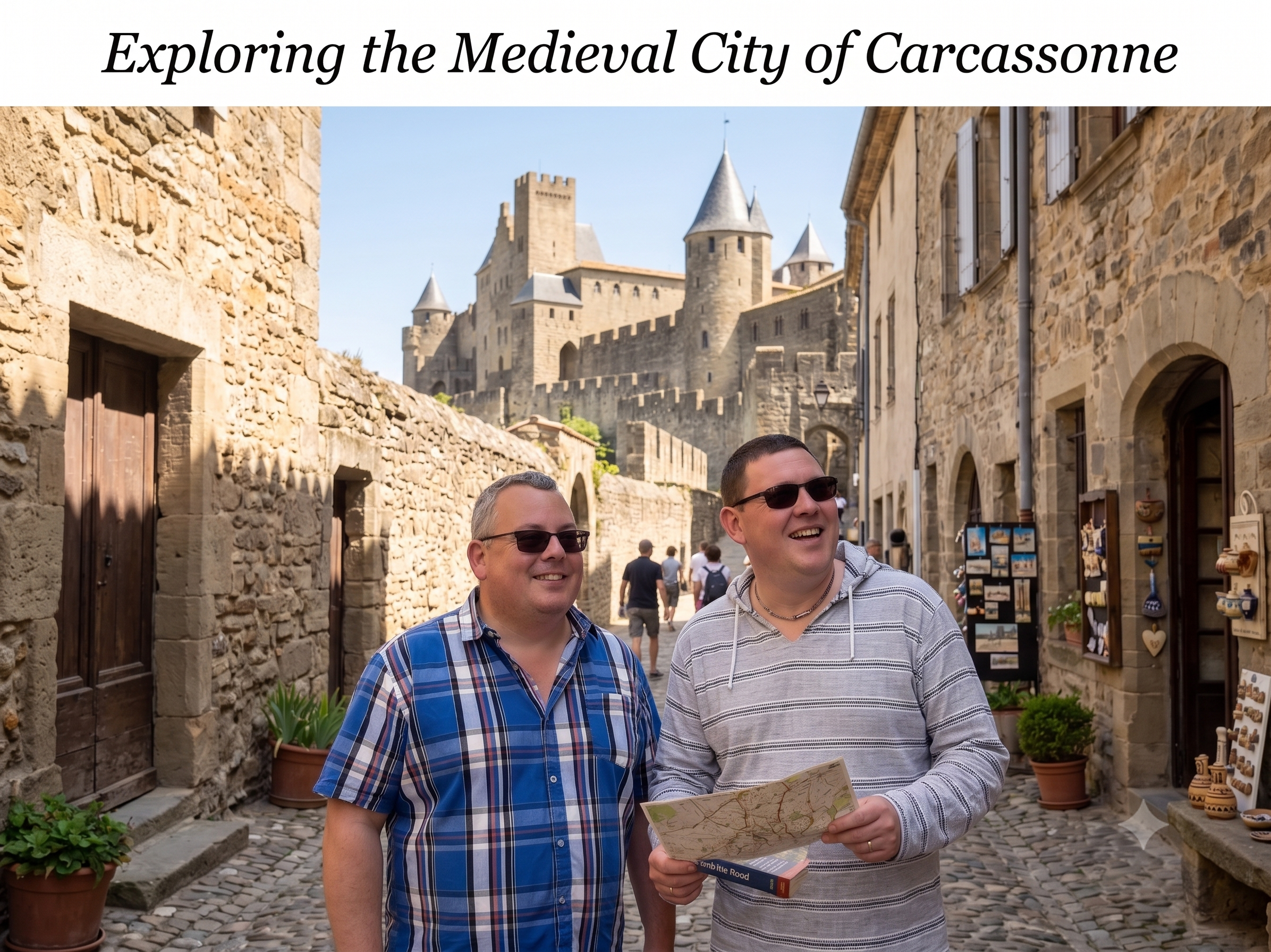
After yesterday’s 700-mile drive across France—and our rather frantic 3.50 am awakening—we had earned a slower start.
A welcome lie-in was followed by a day exploring Carcassonne: walking its ancient ramparts, discovering the Château Comtal and experiencing one of Europe’s most remarkable fortified cities.
A much-needed slower morning
There was no alarm dragging us from bed at an unreasonable hour and, more importantly, no deadline involving an international train.
Our Airbnb, just outside Carcassonne’s walls, provided the perfect base for the day. After recovering from the long journey south, we set out to explore the medieval city we had glimpsed on arrival.
Known locally as La Cité, the fortified city rises dramatically above the River Aude. Its double walls, numerous towers and pointed rooftops create the appearance of a storybook castle—although its history is considerably more complicated than any fairy tale.
Walking around the ramparts
Our exploration began with a walk of approximately two miles around the fortifications.
The scale of Carcassonne is difficult to appreciate until you stand beneath its walls. Tower after tower stretches around the hilltop, creating an extraordinary defensive enclosure that has protected the settlement in various forms for centuries.
From the ramparts, we could look across the terracotta rooftops towards the surrounding countryside. The landscape felt very different from the one we had left behind in northern France the previous morning.
Walking slowly also gave us time to notice the many layers of the city’s architecture. Roman foundations, medieval defences and nineteenth-century restoration all contribute to the Carcassonne seen today.
Just a Minute: Carcassonne
Carcassonne’s story began long before the Middle Ages, with Roman fortifications constructed around the settlement.
The Visigoths strengthened the city during the fifth century, and its defences were expanded considerably during the medieval period. The powerful Trencavel family developed the Château Comtal during the twelfth century before Carcassonne came under the control of the French Crown.
By the nineteenth century, parts of the fortifications faced demolition. Architect Eugène Viollet-le-Duc instead led an extensive—and sometimes controversial—restoration that created much of the city’s distinctive modern appearance.
In 1997, the Historic Fortified City of Carcassonne was inscribed as a UNESCO World Heritage Site.
One minute—and more than 1,500 years of history.
Inside the Château Comtal
At the heart of the fortified city stands the Château Comtal, once the stronghold of Carcassonne’s medieval rulers.
Exploring the castle brought us inside the defensive walls and offered a closer view of their construction. Courtyards, towers, stone passageways and elevated walkways revealed how carefully the fortress had been designed.
The château was not simply an impressive residence. It formed another defensive stronghold within the already fortified city, providing additional protection for those who controlled Carcassonne.
From its walls, we enjoyed impressive views across La Cité and the modern city beyond.
Beyond the fortifications
Carcassonne is more than its walls and castle.
Inside the fortifications, narrow streets weave between shops, restaurants and historic buildings. Although the city attracts visitors from around the world, it remains possible to imagine the generations who once lived, worked and sought shelter within these walls.
We spent the afternoon exploring at a relaxed pace, stopping whenever something caught our attention and enjoying the freedom of having nowhere else to be.
After yesterday’s relentless motorways, travelling two miles on foot felt wonderfully civilised.
Dinner at Le Jardin de l’Estagnol
At 7.00 pm, we finished the day with dinner at Le Jardin de l’Estagnol.
It was an opportunity to relax, enjoy our first proper evening in southern France and reflect upon everything we had seen.
Carcassonne had provided an extraordinary opening to the holiday. Its walls connected Roman, Visigothic and medieval history, while its restoration demonstrated how easily such heritage might have been lost.
Tomorrow, the Canal du Midi
The following morning, we would leave Carcassonne and travel to Castelnaudary, stopping for supplies before boarding our boat at Le Grand Bassin.
After months of planning, our Canal du Midi journey was almost ready to begin.
For now, however, Carcassonne had given us exactly what we needed: a slower day, a remarkable walk through history and an evening spent anticipating the adventure ahead.