Publié le

Day 3: Boarding Our Boat in Castelnaudary

After two days on the road and exploring Carcassonne, the moment we had been waiting for finally arrived: it was time to board our boat and begin our journey along the Canal du Midi.

We left Carcassonne, stocked up on provisions and drove to Castelnaudary, where our boat awaited us beside the vast waters of Le Grand Bassin.

Preparing for life aboard

Before reaching the marina, we stopped to buy everything needed for the journey ahead.

Planning meals for a boating holiday always involves striking a delicate balance. We needed enough food and wine to sustain us between villages, but everything still had to fit inside the boat’s relatively compact cupboards and refrigerator.

With the shopping completed—and considerably more supplies than two people could reasonably require—we continued towards Castelnaudary.

Arriving at Le Grand Bassin

Our starting point was Le Grand Bassin, an impressive expanse of water on the edge of Castelnaudary.

Created as part of the Canal du Midi, the basin once served as an important commercial port. Today, its broad waters provide a striking contrast to the narrow canal channels that would define much of our journey.

At 11.00 am, we arrived at the base, completed the formalities and were introduced to our temporary home.

After a boat handover, safety briefing and explanation of the controls, it was time to unpack. Bags disappeared into cabins, food filled the cupboards and bottles were carefully secured against the inevitable bumps ahead.

Just a Minute: the Canal du Midi

Construction of the Canal du Midi began in 1666 under the direction of Pierre-Paul Riquet.

Completed in 1681, it created a navigable route through southern France, connecting Toulouse with the Mediterranean. Together with the River Garonne and the Canal de Garonne, it helped establish an inland passage between the Atlantic and Mediterranean.

Its construction required an extraordinary network of locks, aqueducts, bridges and reservoirs. Riquet’s greatest challenge was supplying the canal with sufficient water—a problem addressed through an innovative system drawing water from the Montagne Noire.

The Canal du Midi became a UNESCO World Heritage Site in 1996. Our holiday therefore took place during the thirtieth anniversary year of that recognition.

One minute—and more than three centuries of remarkable engineering.

Learning a new boat

However experienced you may be on the water, every hire boat behaves differently.

The steering responds differently, the engine has its own character and stopping distances are generally discovered through a mixture of instruction, judgement and mild alarm.

We familiarised ourselves with the controls and checked the equipment before preparing to leave Le Grand Bassin.

Ahead of us lay an ambitious first cruise: approximately 16 kilometres from Castelnaudary to Bram, taking around five and a half hours and passing through 18 locks.

It was certainly not the gentlest possible introduction.

Leaving Castelnaudary

With everything aboard, we started the engine and eased away from the base.

Months of research, route planning and anticipation had finally become real. We were no longer merely discussing a Canal du Midi holiday—we were navigating it.

The broad waters of Le Grand Bassin gradually gave way to the canal itself. Plane trees, towpaths and the landscape of southern France surrounded us as Castelnaudary began to disappear behind the boat.

There was little time to become sentimental.

Our first lock—and another 17 after it—was waiting.
Publié le

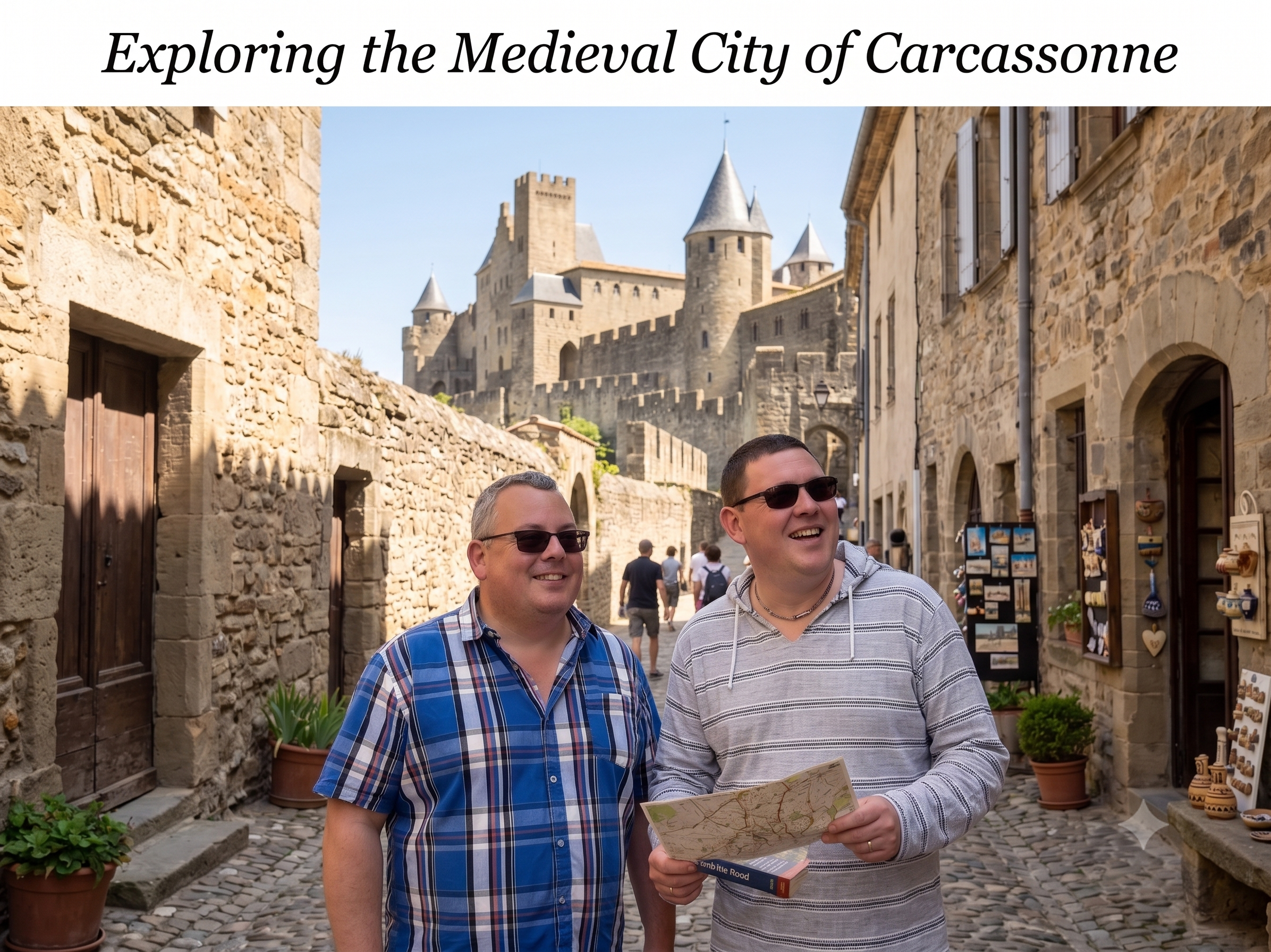
Day 2: Exploring the Medieval City of Carcassonne

After yesterday’s 700-mile drive across France—and our rather frantic 3.50 am awakening—we had earned a slower start.

A welcome lie-in was followed by a day exploring Carcassonne: walking its ancient ramparts, discovering the Château Comtal and experiencing one of Europe’s most remarkable fortified cities.

A much-needed slower morning

There was no alarm dragging us from bed at an unreasonable hour and, more importantly, no deadline involving an international train.

Our Airbnb, just outside Carcassonne’s walls, provided the perfect base for the day. After recovering from the long journey south, we set out to explore the medieval city we had glimpsed on arrival.

Known locally as La Cité, the fortified city rises dramatically above the River Aude. Its double walls, numerous towers and pointed rooftops create the appearance of a storybook castle—although its history is considerably more complicated than any fairy tale.

Walking around the ramparts

Our exploration began with a walk of approximately two miles around the fortifications.

The scale of Carcassonne is difficult to appreciate until you stand beneath its walls. Tower after tower stretches around the hilltop, creating an extraordinary defensive enclosure that has protected the settlement in various forms for centuries.

From the ramparts, we could look across the terracotta rooftops towards the surrounding countryside. The landscape felt very different from the one we had left behind in northern France the previous morning.

Walking slowly also gave us time to notice the many layers of the city’s architecture. Roman foundations, medieval defences and nineteenth-century restoration all contribute to the Carcassonne seen today.

Just a Minute: Carcassonne

Carcassonne’s story began long before the Middle Ages, with Roman fortifications constructed around the settlement.

The Visigoths strengthened the city during the fifth century, and its defences were expanded considerably during the medieval period. The powerful Trencavel family developed the Château Comtal during the twelfth century before Carcassonne came under the control of the French Crown.

By the nineteenth century, parts of the fortifications faced demolition. Architect Eugène Viollet-le-Duc instead led an extensive—and sometimes controversial—restoration that created much of the city’s distinctive modern appearance.

In 1997, the Historic Fortified City of Carcassonne was inscribed as a UNESCO World Heritage Site.

One minute—and more than 1,500 years of history.

Inside the Château Comtal

At the heart of the fortified city stands the Château Comtal, once the stronghold of Carcassonne’s medieval rulers.

Exploring the castle brought us inside the defensive walls and offered a closer view of their construction. Courtyards, towers, stone passageways and elevated walkways revealed how carefully the fortress had been designed.

The château was not simply an impressive residence. It formed another defensive stronghold within the already fortified city, providing additional protection for those who controlled Carcassonne.

From its walls, we enjoyed impressive views across La Cité and the modern city beyond.

Beyond the fortifications

Carcassonne is more than its walls and castle.

Inside the fortifications, narrow streets weave between shops, restaurants and historic buildings. Although the city attracts visitors from around the world, it remains possible to imagine the generations who once lived, worked and sought shelter within these walls.

We spent the afternoon exploring at a relaxed pace, stopping whenever something caught our attention and enjoying the freedom of having nowhere else to be.

After yesterday’s relentless motorways, travelling two miles on foot felt wonderfully civilised.

Dinner at Le Jardin de l’Estagnol

At 7.00 pm, we finished the day with dinner at Le Jardin de l’Estagnol.

It was an opportunity to relax, enjoy our first proper evening in southern France and reflect upon everything we had seen.

Carcassonne had provided an extraordinary opening to the holiday. Its walls connected Roman, Visigothic and medieval history, while its restoration demonstrated how easily such heritage might have been lost.

Tomorrow, the Canal du Midi

The following morning, we would leave Carcassonne and travel to Castelnaudary, stopping for supplies before boarding our boat at Le Grand Bassin.

After months of planning, our Canal du Midi journey was almost ready to begin.

For now, however, Carcassonne had given us exactly what we needed: a slower day, a remarkable walk through history and an evening spent anticipating the adventure ahead.

Publié le

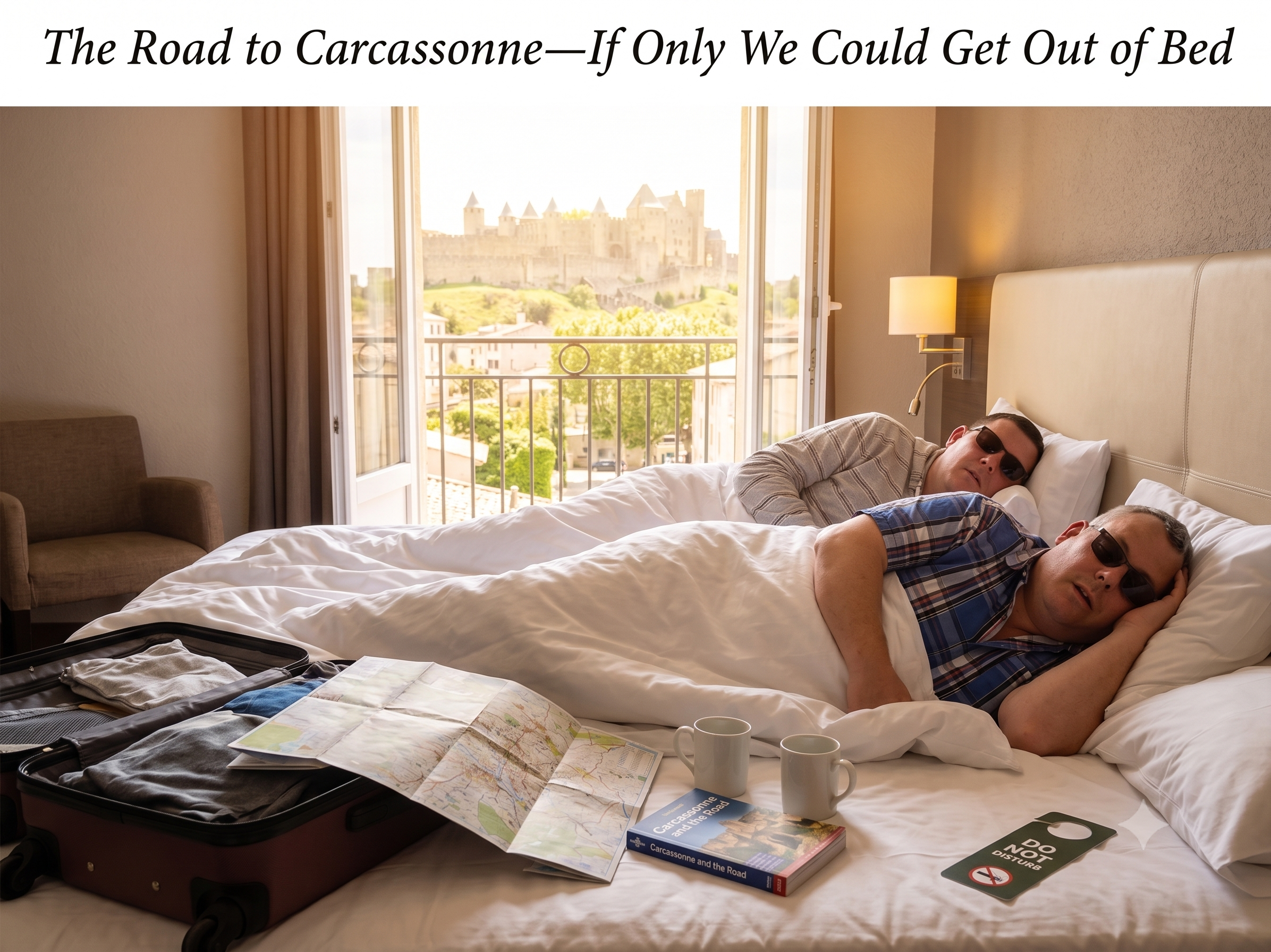
Day 1: The Road to Carcassonne—If Only We Could Get Out of Bed

Every great adventure begins somewhere.

Ours began at 3.50 am, when Chris and Adam woke to discover that they had overslept for a planned 4.00 am departure.

After months of preparation, carefully calculated timings and detailed holiday planning, we had allowed ourselves precisely ten minutes to get out of bed, load the final bags and begin driving to France.

It was an impressively chaotic start to our Canal du Midi adventure.

Ten minutes to departure

The alarm—or our response to it—had not gone entirely according to plan.

Our intention had been to leave home at 4.00 am, giving us ample time to reach Folkestone for our 6.20 am LeShuttle crossing.

Instead, we woke ten minutes before departure.

What followed was less a calm beginning to the holiday and more a hastily choreographed evacuation. Clothes were pulled on, bags were checked and anything not already packed immediately became somebody else’s problem.

Somehow, we got on the road.

Crossing to France

With the first crisis narrowly behind us, we reached Folkestone and boarded LeShuttle for the short journey beneath the English Channel.

The crossing marked the real beginning of our holiday. Britain disappeared behind us and, within approximately 35 minutes, we emerged in Calais with an enormous drive still ahead.

Our destination was Carcassonne—around 700 miles away in southern France.

Calais to Carcassonne

Leaving Calais at approximately 7.55 am, we began the long journey south.

The drive would take around 12 hours, carrying us almost the entire length of France. It was a demanding way to begin a holiday, but it allowed us to bring everything needed for more than a week aboard—including, inevitably, considerably more than we were ever likely to use.

Motorways replaced canals for the day as we travelled from northern France towards Occitanie.

The landscape gradually changed around us. The flatter scenery of the north gave way to the warmer colours and increasingly distinctive character of southern France.

Every mile brought us closer to Carcassonne—and to the Canal du Midi.

Our first sight of Carcassonne

After a journey of approximately 700 miles, reaching Carcassonne brought an enormous sense of relief.

The medieval fortified city dominates the surrounding landscape, with its walls, towers and hilltop position creating one of the most recognisable views in France.

Our Airbnb was situated just outside the city walls, placing us within easy reach of the historic centre while giving us somewhere comfortable to recover from the drive.

After beginning the day in a ten-minute panic and spending most of it crossing France, we had finally arrived.

The adventure begins

Tomorrow would be devoted to exploring Carcassonne properly.

For tonight, simply reaching it felt like an achievement.

The Canal du Midi was waiting, our boat would be ready in Castelnaudary in two days, and more than a week of locks, villages, vineyards and waterways lay ahead.

Our journey may not have started with exemplary timekeeping, but the adventure was now firmly under way.