Publié le

Day 2: From Gretna Green to Laggan—Our Caledonian Canal Adventure Begins

After spending our first night in Scotland at historic Gretna Green, it was time to continue north towards the real beginning of our adventure.

Our destination was Laggan, where our hire boat awaited us on the Caledonian Canal. After months of anticipation—and a long journey from East Sussex—we were finally going to step aboard and begin exploring the Scottish Highlands from the water.

Farewell to Gretna Green

We began the day with a hearty Scottish breakfast, providing essential fuel for the drive ahead.

Gretna Green had been an enjoyable introduction to Scotland. Its history of runaway weddings, anvil ceremonies and romantic rebellion made it much more than a convenient overnight stop.

However, the Highlands were calling.

After loading the car, Chris and I set off with Neil and Naomi for the journey north. The previous day had been about covering the distance from home; today, the changing landscape became an important part of the adventure.

Driving into the Highlands

As we travelled north, Scotland gradually revealed its more dramatic character.

The scenery became increasingly spectacular: wooded valleys, open hills and lochs reflecting the shifting sky. Mountains rose around us as the road carried us deeper into the Highlands.

Almost every bend seemed to reveal another view worthy of a photograph.

After the long motorways of the previous day, this part of the journey felt completely different. The landscape demanded our attention and built our anticipation for the days ahead.

We were approaching the Great Glen—an immense natural fault line cutting across the Highlands from Fort William to Inverness and forming the route followed by the Caledonian Canal.

Arriving at Laggan

Eventually, we reached Laggan and caught our first proper sight of the waterway that would become our home for the coming days.

The Caledonian Canal stretches for approximately 60 miles across the Scottish Highlands, connecting Corpach, near Fort William, with Inverness. Rather than being entirely artificial, much of its route passes through the natural waters of Loch Lochy, Loch Oich, Loch Ness and Loch Dochfour.

Only around one-third of the route consists of constructed canal sections. Together, they create a navigable passage between Scotland’s east and west coasts through some of the country’s most extraordinary scenery.

After travelling for two days by road, seeing the canal before us made the holiday suddenly feel real.

Meeting our boat

Our hire cruiser was ready and waiting.

Unlike the narrowboats we knew from England, this boat was designed for the broader waters and expansive lochs of the Caledonian Canal. It would be our transport, accommodation and floating viewpoint as we travelled through the Great Glen.

Before setting off, we received a thorough handover and safety briefing. There was plenty to absorb: the controls, equipment, mooring arrangements and practicalities of handling an unfamiliar boat.

Even with previous boating experience, every vessel behaves differently. The scale and exposed nature of the Scottish lochs also meant that weather and water conditions would play a much greater role than on many sheltered canals farther south.

Once the briefing was complete, we began unpacking and transforming the boat into our temporary home.

Settling into life aboard

There is a distinctive moment at the beginning of every boating holiday when bags disappear into cupboards, provisions find their places and an unfamiliar boat starts to feel like your own.

We explored the cabins, organised the galley and worked out where everything needed to go. With four people aboard for several days, good use of space would be important.

Outside, the peaceful surroundings provided an irresistible preview of what awaited us.

The Caledonian Canal felt spacious and remote, framed by wooded hills and Highland scenery. It was very different from the narrower, more enclosed waterways on which we had previously travelled aboard Tilly Mint.

The possibilities ahead felt enormous.

An evening beside the canal

Our first evening at Laggan was deliberately unhurried.

After two days of travelling, there was no need to rush away from the base. Instead, we spent time becoming familiar with the boat and enjoying the tranquillity of our surroundings.

As daylight softened across the water, the canal took on a golden glow. The only sounds were the gentle movement of water against the hull and the occasional signs of life from the surrounding landscape.

Sitting aboard with Chris, Neil and Naomi, it was wonderful to realise that we had finally arrived.

The long drive from East Sussex was behind us. Our provisions were aboard, the briefing was complete and our floating home was ready.

Ready for the Great Glen

Tomorrow, we would begin navigating the Caledonian Canal in earnest.

Ahead lay locks, swing bridges, Highland villages and some of Scotland’s most famous lochs. We would experience the scale of the Great Glen from the water and discover how different this journey would be from our previous canal adventures.

For now, however, we were content simply to be aboard.

Our Scottish canal adventure had officially begun.
Publié le

Driving to Gretna Green: Our Scottish Canal Adventure Begins

After months of anticipation, our 12-day Scottish adventure had finally arrived.

Leaving East Sussex behind, we began the long journey north with our dear friends Neil and Naomi. Their narrowboat, Tilly Mint, had already carried us on many memorable weekends, but this time we were exchanging the familiar canals of southern England for the dramatic landscapes of Scotland and the Caledonian Canal.

Our first destination was not yet the canal itself. We had a considerable distance to travel, so Gretna Green provided the perfect place to break the journey and spend our first night in Scotland.

The long road north

The drive from East Sussex took us along much of the spine of Britain.

As the miles passed, familiar surroundings gradually gave way to the landscapes of northern England. Despite the length of the journey, there was a growing sense of excitement in the car. Every mile carried us closer to the Highlands and the boating adventure we had spent so long imagining.

Travelling with Neil and Naomi made the journey part of the holiday. There was plenty of conversation, laughter and speculation about what the following days might bring.

By the time we crossed the border into Scotland, we were ready to stop—but delighted that the adventure was properly under way.

Our first night in Gretna Green

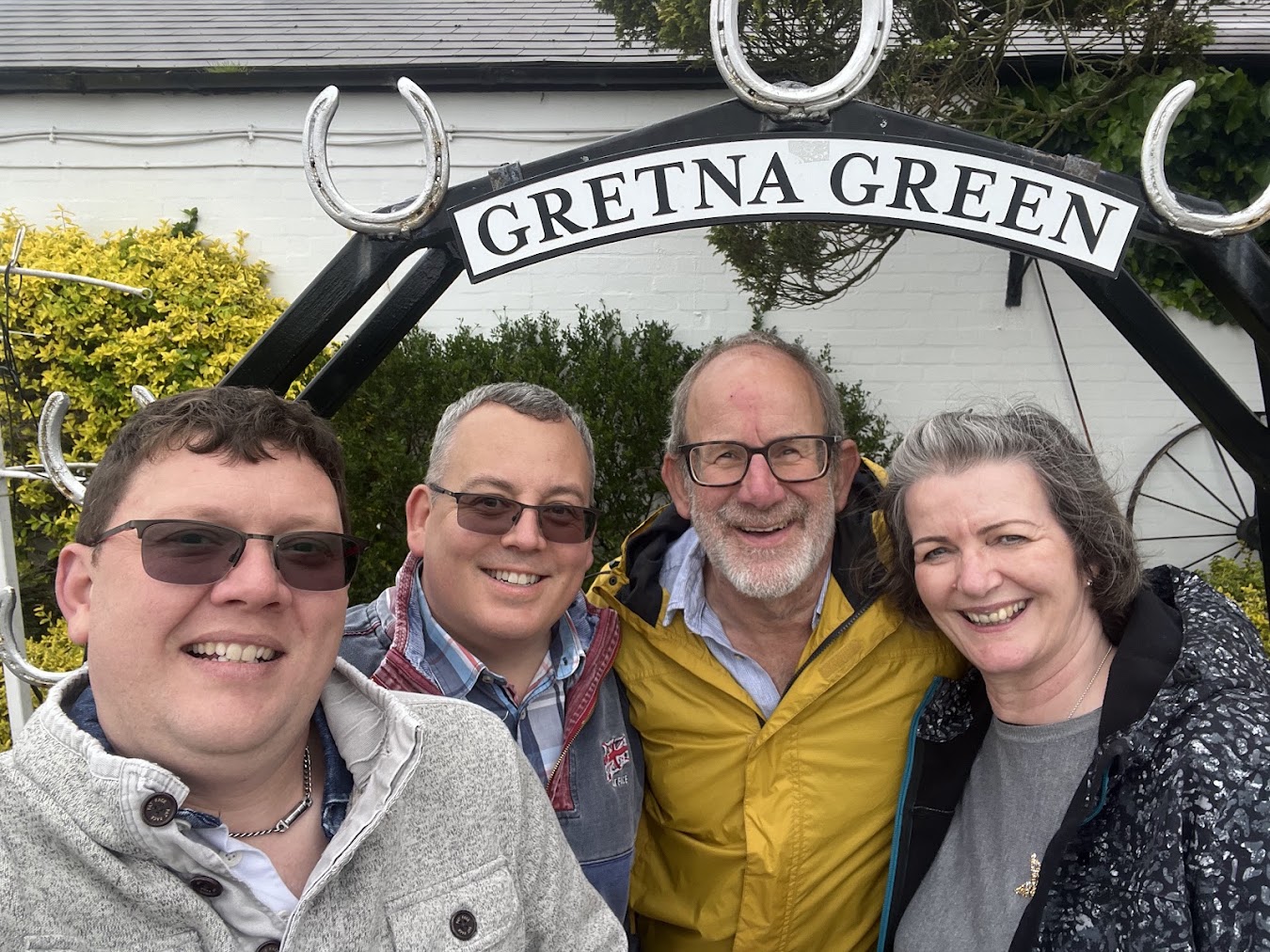
Situated immediately beyond the English border, Gretna Green has welcomed travellers arriving in Scotland for centuries.

For us, it offered a comfortable overnight stop before continuing north. It also gave us an opportunity to explore a village with one of the most romantic—and rebellious—histories in Britain.

Gretna Green became famous following the introduction of the Marriage Act 1754 in England and Wales. The legislation imposed stricter requirements upon marriages, including parental consent for people under the age of 21.

The Act did not apply in Scotland, where couples could marry at a younger age and without the same formalities. Gretna Green was conveniently located just across the border, making it a natural destination for young couples escaping disapproving families.

Marriage over the anvil

The village’s Old Blacksmith’s Shop became particularly associated with these runaway weddings.

Under Scottish law, marriages could historically be conducted by declaration before witnesses. Local blacksmiths became known as “anvil priests”, joining couples together in the same way that they joined pieces of metal.

The anvil consequently became an enduring symbol of marriage at Gretna Green.

It is wonderfully dramatic to imagine couples racing north by carriage, pursued by angry parents and determined to reach Scotland before being caught. The reality may not always have been quite so theatrical, but the stories gave Gretna Green a lasting reputation as the home of romantic rebellion.

Weddings continue to take place there today, preserving a tradition extending back for generations.

An evening with friends

After checking into our accommodation, we had time to wander around the village and absorb some of its history.

This was not intended to be a demanding sightseeing day. After the long drive, a leisurely evening was exactly what we needed.

Dinner with Neil and Naomi provided the perfect conclusion to the first day. We could relax, enjoy each other’s company and look forward to everything awaiting us farther north.

The holiday had begun with roads rather than waterways, but our conversation was already firmly focused upon boats, locks and the Scottish scenery ahead.

Towards the Caledonian Canal

The following morning, we would continue north towards the Caledonian Canal.

Stretching for approximately 60 miles between Corpach, near Fort William, and Inverness, the canal links a series of natural lochs through the Great Glen. Its route includes Loch Lochy, Loch Oich and the immense Loch Ness, surrounded by some of Scotland’s most spectacular scenery.

Unlike the more sheltered waterways we knew, the Caledonian Canal promised vast stretches of open water, mountains rising around us and an entirely different boating experience.

For several days, our hire boat would become both our transport and our home as we explored one of Britain’s greatest waterways.

The adventure begins

Gretna Green may only have been the first stop on our journey, but it marked the moment when the holiday truly began.

We had crossed into Scotland, shared our first evening together and reached the starting point of an adventure that would take us deep into the Highlands.

There were still many miles to travel before we stepped aboard our boat, but the excitement was already building.

Tomorrow, we would continue north—and the Caledonian Canal would be waiting.

Publié le

Bowling Basin: Where the Canal Meets the Clyde

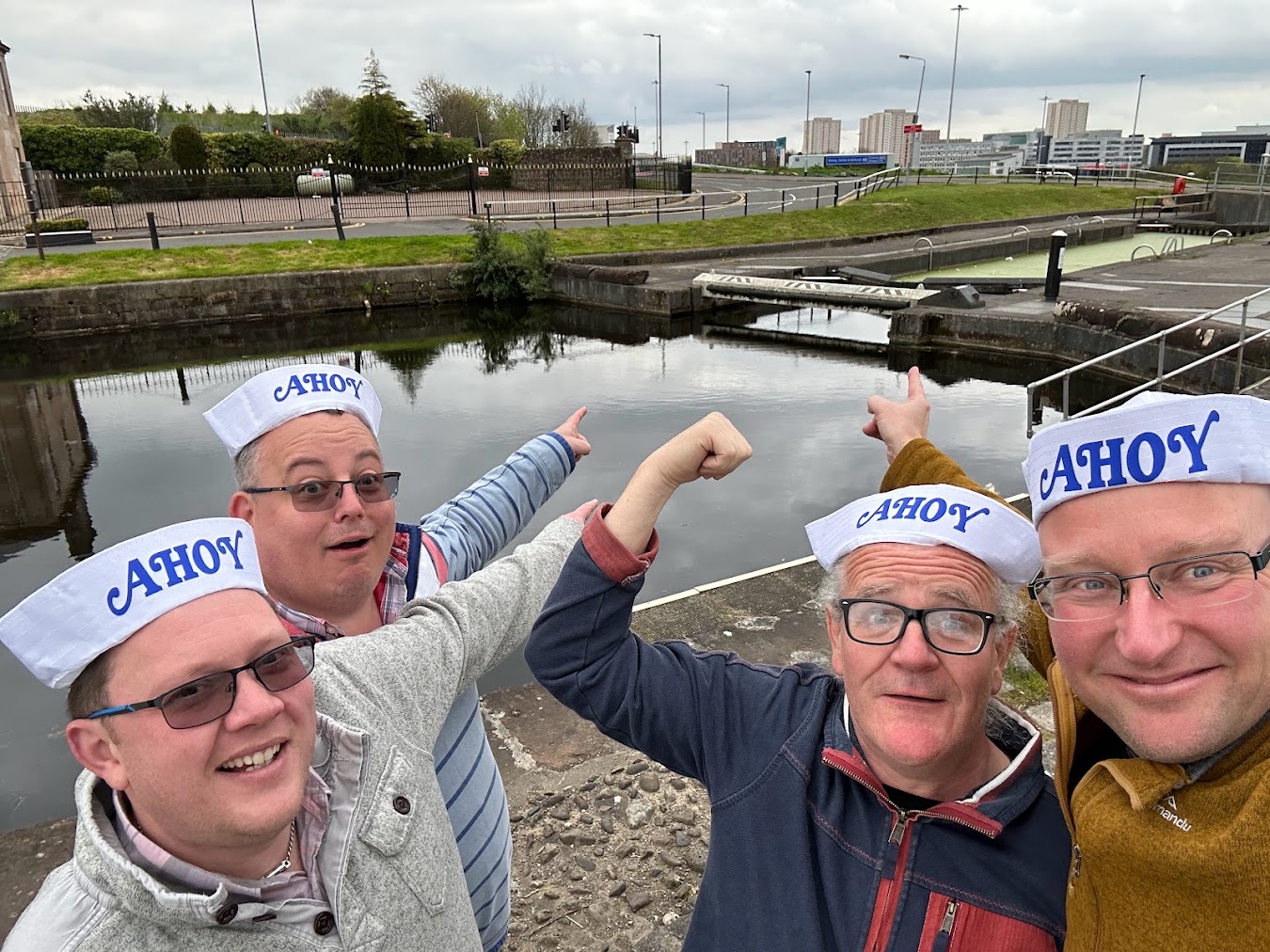
At the western end of the Forth & Clyde Canal lies Bowling Basin, where the sheltered inland waterway meets the broad tidal waters of the River Clyde.

Once a busy industrial harbour, the basin has been transformed into an attractive destination for walkers, cyclists and visitors. Its railway heritage, regenerated arches and expansive views make it a fascinating place to explore—but we could not help feeling that it deserves to welcome many more visitors by water.

Reaching the western end of the canal

After our Scottish waterways holiday, we visited Bowling Basin to see where the Forth & Clyde Canal completes its journey west.

The canal stretches across central Scotland, linking the Clyde with the Forth and creating a navigable route between the country’s east and west coasts. Bowling therefore feels like more than simply another canal basin: it is the threshold between inland cruising and considerably more adventurous tidal waters.

Standing beside the basin, we could look beyond the protective sea lock towards the Clyde and enjoy those wonderful views “doon the watter”.

A harbour shaped by industry

Bowling Basin was once a thriving centre of trade, boatbuilding and industry.

Canal boats brought goods westwards to meet vessels using the Clyde, while the surrounding railways connected the harbour with Scotland’s expanding industrial network. The surviving railway arches, disused tracks and swing bridge all provide reminders of the basin’s working past.

Although the commercial traffic has largely disappeared, its history remains clearly visible. This is not a heritage site preserved behind barriers; it is a landscape that has been adapted and given a new purpose.

A railway transformed

One of Bowling Basin’s most distinctive features is its former railway infrastructure.

The abandoned tracks and striking swing railway bridge have been incorporated into a linear park, allowing visitors to walk through parts of the site that were once dominated by industry. The old railway arches have also been restored and repurposed for small businesses and visitor facilities.

The result is an atmospheric mixture of canal, harbour and railway heritage. Rusting metalwork and old stone structures sit alongside improved paths, landscaped areas and modern activity.

It is regeneration that respects the site’s character rather than attempting to erase it.

Views “doon the watter”

The views from Bowling are tremendous.

Looking west, the Clyde opens towards Dumbarton and the distant hills, creating a dramatic contrast with the narrow, sheltered canal behind. The broad water and changing light give the basin an atmosphere unlike anywhere else along the Forth & Clyde Canal.

It feels simultaneously like the end of one journey and the beginning of another.

For generations of Glaswegians, travelling “doon the watter” meant heading along the Clyde towards the coastal resorts and holiday towns beyond. Standing at Bowling, it was easy to understand the enduring pull of that journey.

A destination deserving more boats

The regeneration work has helped establish Bowling Basin as a popular destination for walkers, cyclists and day visitors.

However, we would love to see more people arriving in the way that feels most appropriate: by boat.

More visiting boats would bring additional life and activity to the basin while strengthening its connection with the wider canal network. It could become a natural destination for boaters travelling west along the Forth & Clyde Canal, rather than simply somewhere to reach, turn around and leave.

With its history, views and restored surroundings, Bowling has all the ingredients needed to become one of Scotland’s most memorable waterways destinations.

Where canal, river and history meet

Our visit to Bowling Basin offered a fitting conclusion to our exploration of the Forth & Clyde Canal.

From the Falkirk Wheel and the journey into Glasgow to the open views across the Clyde, the canal had revealed engineering, industrial heritage and extraordinary contrasts throughout its length.

Bowling brings all those elements together. It is a canal terminus, a former industrial harbour, a regenerated public space and a gateway to the Clyde.

Most importantly, it is a place with enormous potential—both as a destination on land and as somewhere that could once again come alive with boats.

Publié le

Exploring Edinburgh Quay: Where the Union Canal Meets the City

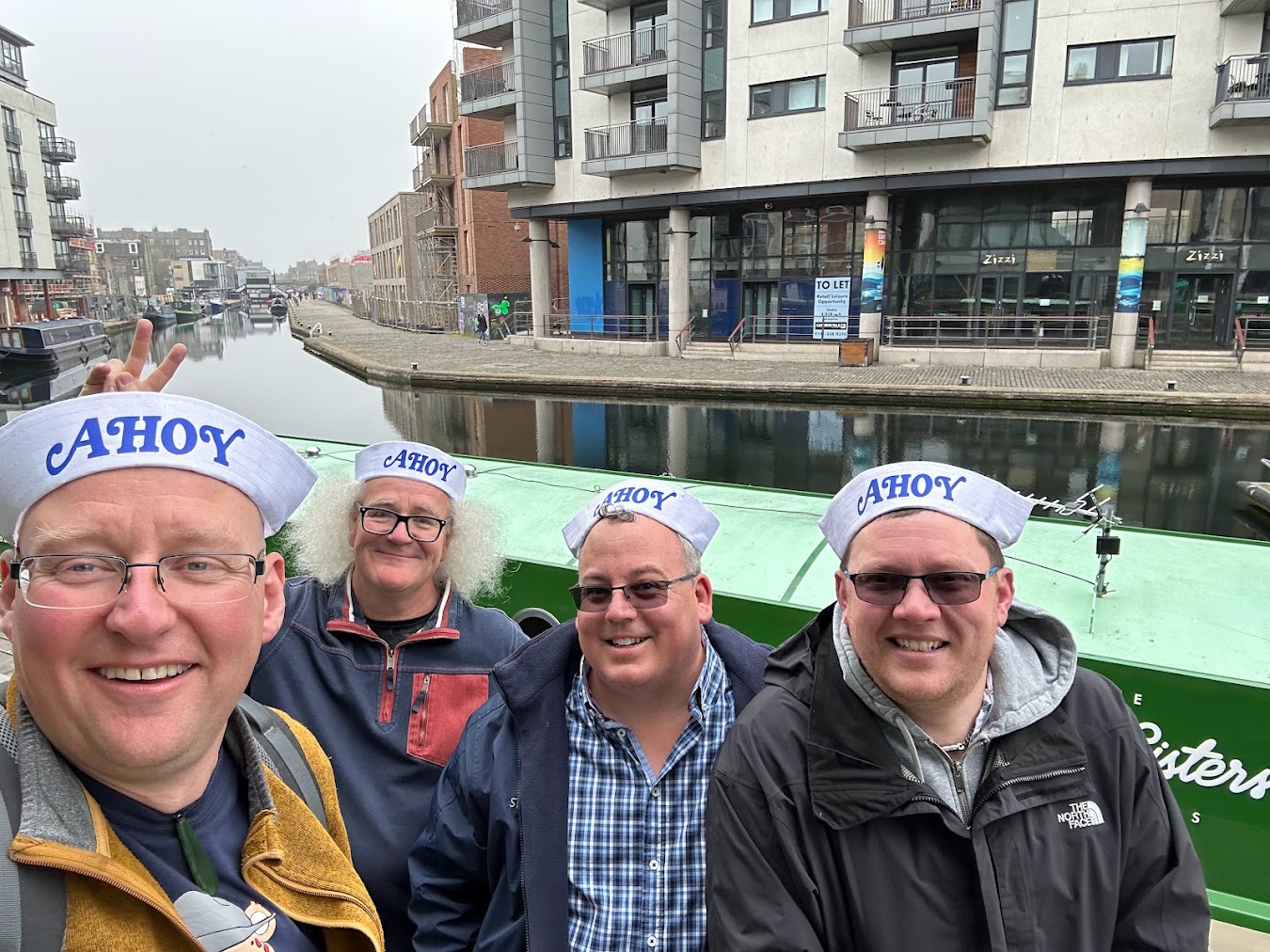
After arriving on the outskirts of Edinburgh aboard Green Sandpiper, we continued our Scottish canal adventure on foot.

Our destination was Edinburgh Quay, the eastern terminus of the Union Canal. Here, the tranquillity of the waterway meets the energy of Scotland’s capital, creating a striking combination of canal heritage and modern city life.

Walking towards Edinburgh Quay

Edinburgh Quay lies at Fountainbridge, within easy walking distance of the city centre.

As we approached, the busy streets gradually gave way to the calmer surroundings of the canal. The towpath offered a welcome escape from the traffic, despite being only a short distance from central Edinburgh.

The contrast was part of its appeal. Modern buildings rose beside the water while narrowboats rested below, creating an unexpected waterside setting in the heart of the city.

The end of the Union Canal

Edinburgh Quay marks the eastern end of the Union Canal, which stretches westwards towards the Falkirk Wheel.

The canal opened in 1822 and was originally used to transport goods and passengers between Edinburgh and central Scotland. After years of decline, it was restored and reopened in 2001 as part of the Millennium Link project.

Standing beside the basin gave us a chance to appreciate the full extent of our journey. We had travelled from Falkirk towards Edinburgh along the same historic waterway that now ended quietly among offices, homes, restaurants and city streets.

A modern waterside destination

The former industrial area around Fountainbridge has changed considerably.

Contemporary buildings now surround the basin, their glass, steel and brickwork reflected in the water below. Cafés, bars and restaurants bring activity to the waterfront, while the towpath remains popular with walkers, runners and cyclists.

Despite the development, the canal retains its distinctive atmosphere. Ducks moved between the moored boats, the water remained calm and the pace felt noticeably slower than the surrounding city.

It was a place where Edinburgh’s industrial heritage and modern identity sat comfortably beside one another.

Exploring the towpath

We spent time walking beside the canal and enjoying the views around the basin.

The level, well-maintained towpath made exploring easy. Benches and open areas offered places to pause, while the boats and waterside architecture provided plenty to photograph.

Following the towpath west would eventually lead all the way back towards Falkirk. From Edinburgh Quay, however, we were content to enjoy a shorter and considerably less ambitious walk.

After several days aboard Green Sandpiper, seeing the canal from the towpath offered a different perspective. Features that pass quickly from the boat could now be examined properly, while the waterway’s relationship with the surrounding city became much clearer.

Canal calm in the capital

Edinburgh is famous for its castle, historic streets and dramatic skyline, but the Union Canal reveals another side of the city.

Edinburgh Quay offered the calm of the waterways without taking us far from the capital’s main attractions. It felt peaceful without being isolated and modern without losing sight of its industrial past.

For us, it was also a fitting destination after travelling east aboard Green Sandpiper. The canal had carried our adventure from the Falkirk Wheel towards the centre of Edinburgh; exploring its terminus on foot brought that part of our journey to a satisfying conclusion.

Publié le

The Falkirk Wheel and Our Journey Towards Edinburgh

After cruising from Falkirk to Glasgow and back again, our Scottish canal adventure was ready to take us in a new direction.

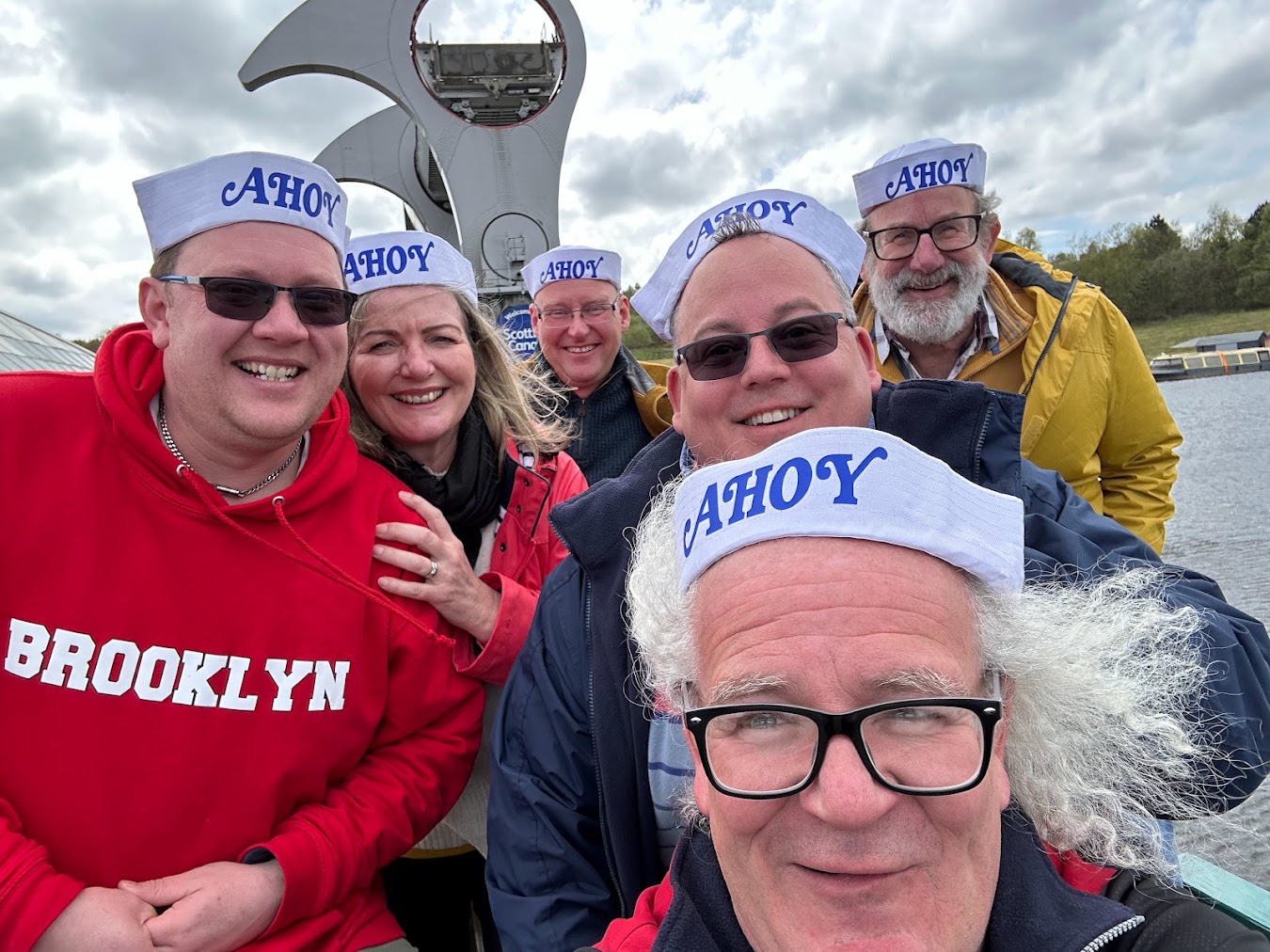
Today, Green Sandpiper carried us to the Falkirk Wheel, where Neil and Naomi joined us for the next stage of our journey. Together, we would experience one of the world’s most remarkable pieces of waterways engineering before continuing east along the Union Canal towards Edinburgh.

Returning to the Falkirk Wheel

We left our overnight mooring and continued towards Falkirk, excited to return to the structure that had provided such an impressive backdrop at the beginning of our holiday.

The Falkirk Wheel reconnects the Forth & Clyde Canal with the Union Canal, overcoming a height difference of approximately 35 metres. Opened in 2002, it replaced the historic flight of locks that once linked the two waterways.

As the Wheel came into view, it was difficult not to be impressed by its scale and distinctive design. Even after seeing it from the towpath, travelling through it aboard Green Sandpiper promised an entirely different experience.

Reunited with Neil and Naomi

Neil and Naomi met us at the Falkirk Wheel, ready to join the adventure.

Warm greetings quickly gave way to laughter and stories from our respective journeys. Having shared many previous boating experiences, their arrival felt less like welcoming visitors and more like reassembling a familiar crew.

With everyone aboard, it was time for the moment we had been anticipating: taking Green Sandpiper through the Falkirk Wheel.

Travelling through the Falkirk Wheel

We guided the boat into one of the Wheel’s water-filled gondolas and waited for the gates to close behind us.

The Wheel then began its slow rotation, lifting Green Sandpiper smoothly upwards as the opposite gondola descended. Despite carrying the combined weight of boats and water, the movement felt controlled and surprisingly gentle.

As we rose, the surrounding landscape gradually opened before us. The higher we travelled, the more extensive the views became, revealing Falkirk and the green countryside beyond.

It was a remarkable experience: part boat journey, part engineering demonstration and unlike anything else on Britain’s inland waterways.

From the Wheel to the Union Canal

Reaching the upper level did not quite complete the ascent.

After leaving the Wheel, we passed through the Roughcastle Tunnel and continued towards a pair of locks that raised us through the remaining height difference to the Union Canal.

Emerging onto the canal felt like crossing a threshold. Behind us lay the Forth & Clyde Canal and our journey to Glasgow; ahead was a largely lock-free route stretching east towards Edinburgh.

With the Wheel safely negotiated and the crew reunited, we turned Green Sandpiper towards the capital.

Cruising towards Edinburgh

The Union Canal offered a noticeably different cruising experience.

Built as a contour canal, it follows the landscape at a relatively consistent level, avoiding the frequent locks found on many other waterways. This allowed us to settle into a gentler rhythm as we travelled east.

The canal carried us through peaceful countryside, past woodland, villages and open views. Travelling at narrowboat pace gave us time to appreciate details that would have disappeared quickly from a road or railway journey.

Conversations flowed easily aboard the boat. Stories, jokes and memories filled the day as familiar friendships slipped naturally back into place.

An evening near Edinburgh

By the end of the day, we had reached the outskirts of Edinburgh.

After the excitement of the Falkirk Wheel and a long afternoon of cruising, we found a suitable place to moor for the night. The boat was secured, dinner prepared and the crew began settling down after another memorable day.

Edinburgh now felt tantalisingly close. Tomorrow would bring the final approach into Scotland’s capital and the opportunity to explore another vibrant city from the water.

A landmark day on the waterways

Travelling through the Falkirk Wheel was always going to be one of the defining moments of our Scottish canal holiday.

The extraordinary engineering alone made the experience special, but sharing it with Chris, Dan, Jeff, Neil and Naomi made it even more memorable.

Our journey had already taken us from Falkirk to Glasgow and back. Now, lifted onto the Union Canal, Green Sandpiper was carrying us towards Edinburgh and the next chapter of our adventure.

Publié le

From Tranquil Waters to Glasgow’s Bustling Streets

After our first evening aboard Green Sandpiper at Falkirk, it was finally time to begin our Scottish canal journey.

Chris, Dan, Jeff and I cast off and headed west along the Forth & Clyde Canal towards Port Dundas in Glasgow. Ahead of us lay a day of peaceful cruising through the Scottish countryside, followed by an evening exploring the energy, flavours and nightlife of the city.

Leaving Falkirk behind

We set off from Falkirk with the excitement that accompanies the first proper day of any boating holiday.

The Falkirk Wheel and the anticipation of the previous evening were now behind us. Green Sandpiper was unpacked, the crew had settled aboard and we were ready to discover the canal linking Falkirk with Glasgow.

The gentle sound of the engine and the water moving against the hull soon established the unhurried rhythm of the journey.

After two days spent travelling by car, it felt wonderful to be moving at narrowboat pace.

Cruising the Forth & Clyde Canal

The Forth & Clyde Canal stretches for approximately 35 miles between the River Forth and the River Clyde.

Completed in 1790, it once provided an important commercial route across central Scotland. Today, its restored waters offer a fascinating journey through countryside, towns and the increasingly urban landscape approaching Glasgow.

Our route carried us through lush greenery, with trees arching over parts of the canal and patches of sunlight moving across the water.

The peaceful surroundings encouraged us to slow down and appreciate the landscape properly. Wildlife appeared along the banks, the occasional boat passed us and everyday life seemed comfortably distant.

Locks, bridges and canal history

The journey towards Glasgow involved more than simply following the water.

Locks and bridges punctuated the route, each one introducing another small task for the crew. Ropes were handled, gates and paddles operated and Green Sandpiper was carefully guided from one level to the next.

Working through the canal’s structures gave us a much closer connection with the waterway and its history. These practical features are reminders that the canal was created as a working transport route rather than merely somewhere for modern leisure cruising.

They also ensured that nobody aboard could become too comfortable for long.

Countryside gives way to the city

As we drew closer to Glasgow, the character of the journey gradually changed.

The quiet greenery began to give way to roads, bridges, buildings and the unmistakable signs of a major city. The contrast was striking: we had travelled from peaceful countryside into the heart of urban Scotland without leaving the canal.

That transformation is one of the pleasures of travelling by narrowboat. Landscapes do not change abruptly as they might from a car or train. Instead, the countryside slowly becomes suburban and the suburbs gradually merge into the city.

Glasgow seemed to unfold around us.

Arriving at Port Dundas

Our destination was Port Dundas, once an important industrial canal basin and the historic Glasgow terminus of the Forth & Clyde Canal.

Reaching it felt like a genuine achievement. We had travelled into Glasgow by boat, following a route shaped by more than two centuries of industrial and waterways history.

Once Green Sandpiper was safely moored, we exchanged the tranquillity of the canal for the bustle of the city streets.

The change of pace was immediate. After a day governed by locks, bridges and narrowboat speed, Glasgow offered traffic, crowds, restaurants and an entirely different kind of energy.

An evening in Glasgow

We set out to explore the city and enjoy the lively atmosphere.

Glasgow’s mixture of impressive architecture, busy streets and famously sociable character made it an exciting destination after our peaceful day aboard.

Dinner was at a highly regarded local Indian restaurant. Glasgow has an excellent reputation for Indian food, and our meal certainly lived up to expectations.

After eating extremely well—and perhaps enjoying the evening a little too enthusiastically—we decided that walking back to Port Dundas was no longer an attractive proposition.

An Uber returned us safely to the canal and our waiting boat.

Home to Green Sandpiper

Stepping back aboard felt like returning home.

Despite having known Green Sandpiper for only a short time, its compact and familiar interior already offered a comforting contrast to the busy city outside.

We settled down for a peaceful night, tired from the day’s cruising and our evening in Glasgow.

Tomorrow, we would retrace our route towards Falkirk. For now, the boat was secure, the crew was content and Port Dundas provided our unlikely city-centre home.

Two sides of Scotland in one day

Our journey from Falkirk to Glasgow revealed two very different sides of Scotland.

The day began with tranquil water, greenery and the measured rhythm of locks. It ended among the restaurants, streets and vibrant atmosphere of one of Britain’s great cities.

Travelling by canal allowed the transition between them to unfold slowly, turning the journey itself into an essential part of the experience.

From the peaceful waters of the Forth & Clyde Canal to dinner in the heart of Glasgow, it had been another memorable chapter in our Scottish adventure.

Next, we would turn Green Sandpiper around and begin our return journey to Falkirk.

Publié le

The Kelpies and the Beginning of Our Scottish Canal Adventure

After the long drive from London to Glasgow—and our cold, wet diversion to Hadrian’s Wall—the second stage of our Scottish adventure took us to Falkirk.

Chris, Dan, Jeff and I left the DoubleTree by Hilton after breakfast, excited to reach the canal and collect our boat. Before boarding, however, we had one important stop to make: The Kelpies.

Leaving Glasgow

Rested after a comfortable night in Glasgow, we repacked the car and prepared for the relatively short journey to Falkirk.

Chris resumed his role as designated driver, while Jeff once again took responsibility for the soundtrack. Dan and I contributed through encouragement, navigation and the occasional unnecessary observation from the passenger seats.

Unlike the previous day’s long journey north, Falkirk was now within easy reach. Our Scottish canal holiday was about to move from roads to waterways.

First, though, two enormous horses were waiting for us.

Our first sight of The Kelpies

The Kelpies are difficult to appreciate fully until you stand beneath them.

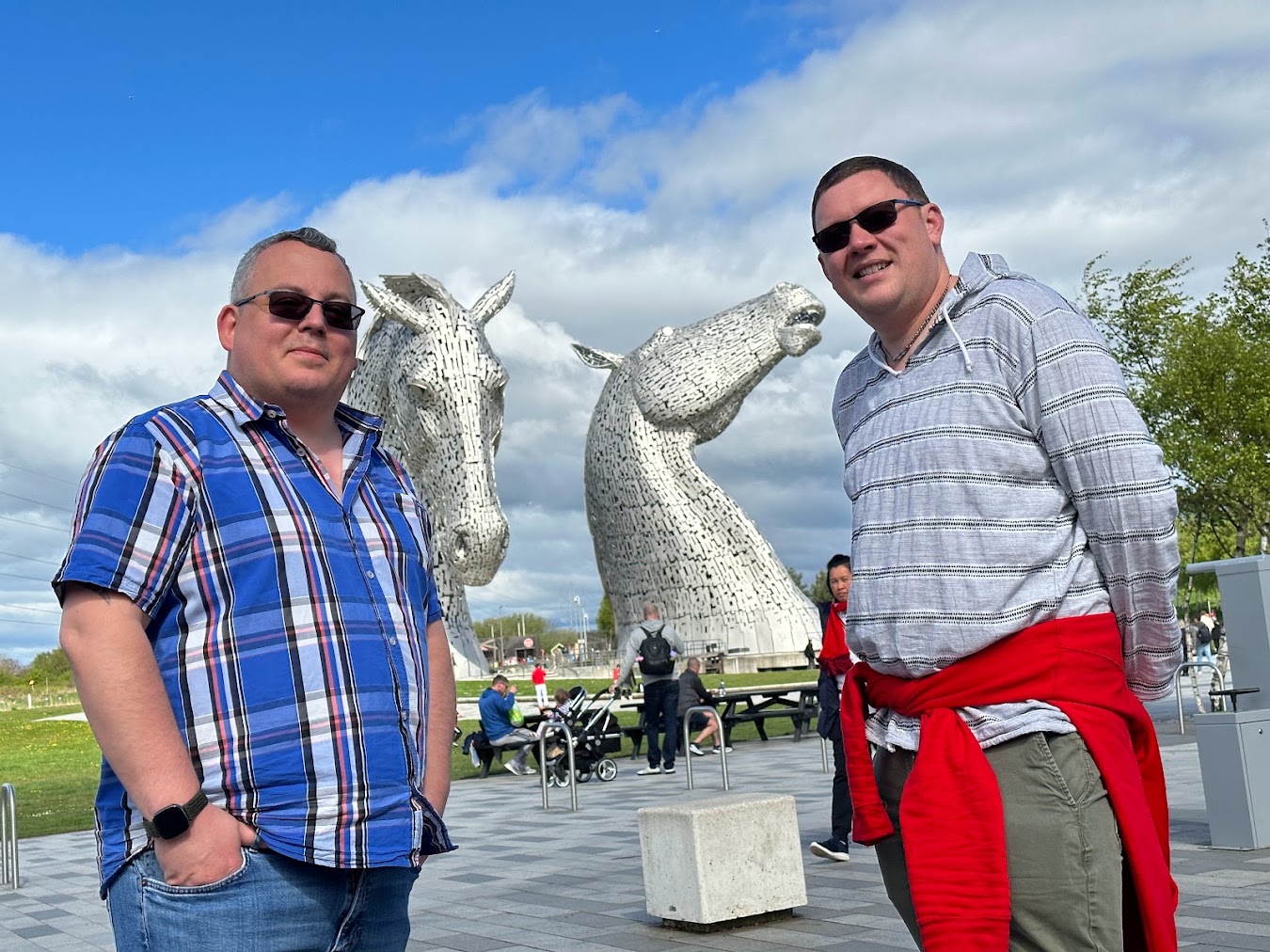
Rising approximately 30 metres above the surrounding landscape, the two steel-clad horse heads dominate The Helix park near Falkirk. Their scale is extraordinary, but so too is the detail in their construction: thousands of individual steel plates combine to create expressions that appear to change as you move around them.

Designed by sculptor Andy Scott, The Kelpies celebrate the powerful working horses that once helped drive Scotland’s industries and pulled boats along its canals.

The sculptures therefore felt like an especially appropriate place to visit at the beginning of our boating holiday.

Giants beside the canal

From a distance, The Kelpies appear almost impossibly polished and precise. Up close, their size becomes overwhelming.

We walked around their bases, looking upwards as the light moved across the steel surfaces. Each change of position revealed a different shape, expression or reflection.

Jeff’s road-trip playlist had accompanied us into the car park, providing an unexpectedly dramatic soundtrack to our arrival. After many hours of music on the road, it seemed fitting that DJ Jeff’s contribution should continue right up to one of Scotland’s most impressive modern landmarks.

The Kelpies also stand beside a specially created extension of the Forth & Clyde Canal, forming a striking eastern gateway to the historic waterway.

A Silver Propeller destination

Our visit also carried particular significance because The Kelpies are one of the locations associated with the Inland Waterways Association’s Silver Propeller Challenge.

The challenge encourages boaters to explore the more distant and less frequently visited parts of Britain’s connected inland waterways. Reaching qualifying locations provides a compelling reason to venture beyond familiar cruising routes and experience places that might otherwise be overlooked.

Although we had arrived by car on this occasion, seeing The Kelpies strengthened our ambition to explore as much of the inland waterway network as possible.

It was another landmark added to our growing waterways story—and certainly one of the largest.

Onwards to Falkirk

After taking photographs and admiring the sculptures from every reasonable angle, it was time to continue towards Falkirk.

The Kelpies gradually disappeared behind us as we returned to the road. Leaving them felt slightly bittersweet, but our main adventure was now only minutes away.

As we approached our destination, another extraordinary structure appeared: the Falkirk Wheel.

The world’s only rotating boat lift reconnects the Forth & Clyde Canal with the Union Canal. Its sweeping arms raise and lower boats between the two waterways, replacing the historic flight of locks that once performed the same task.

Having seen photographs and videos of the Wheel, arriving beside it was an exciting moment. This was not simply another attraction on our itinerary—it was the starting point for our journey across Scotland’s central canal network.

Meeting Green Sandpiper

Waiting for us at Falkirk was our home for the next few days: Green Sandpiper.

We unloaded the car and transferred our luggage aboard, gradually transforming an unfamiliar hire boat into our temporary floating home.

There is always a particular excitement when stepping aboard at the beginning of a boating holiday. Cupboards must be explored, beds allocated and controls understood. Bags occupy every available surface until someone decides where everything should live.

Despite the inevitable unpacking chaos, Green Sandpiper quickly began to feel comfortable and welcoming.

Once we had settled in, we spent time exploring the boat and preparing for the journey ahead.

Our first evening aboard

Rather than rushing away from Falkirk, we remained aboard for the rest of the afternoon and evening.

It gave us time to relax after two days of travelling and to become familiar with the boat before setting off. Board games emerged, drinks were poured and laughter soon filled the cabin.

There was something deeply satisfying about finally being on the water. The long drive from London, our rain-soaked visit to Hadrian’s Wall and the morning’s encounter with The Kelpies had all brought us to this point.

Outside, the Falkirk Wheel provided a remarkable backdrop. Inside, Green Sandpiper already felt like home.

Tomorrow: towards Glasgow

The following morning, we would begin our cruise west towards Glasgow along the Forth & Clyde Canal.

The route promised historic locks, aqueducts, bridges and constantly changing scenery. Later in the holiday, the Falkirk Wheel would lift us onto the Union Canal for the journey east towards Edinburgh.

For now, however, there was no need to think too far ahead.

Our luggage was aboard, our crew was assembled and our Scottish canal adventure had officially begun.
The Kelpies had provided a spectacular introduction. The Falkirk Wheel was waiting. Tomorrow, we would finally cast off.

Publié le

Driving to Scotland via Hadrian’s Wall

Every narrowboat holiday begins with a journey to the water—and our adventure across Scotland’s canals began with a road trip of its own.

Chris, our friends Dan and Jeff, and I set off from our former home at the Royal Arsenal in London, bound for Glasgow. The following day, we would continue to Falkirk and board our narrowboat for a journey along the Forth & Clyde and Union canals to Edinburgh.

Before reaching Scotland, however, we had planned a suitably historic diversion: Hadrian’s Wall.

Leaving London behind

We loaded the luggage into the car early that morning, anticipating the long journey north.

Chris assumed responsibility for the driving, while the rest of us settled into our considerably less demanding roles as navigator, refreshment coordinator and provider of unsolicited driving advice.

Jeff took charge of the music. His playlist moved confidently between classic rock and contemporary pop, transforming the car into a mobile concert venue as we left London behind.

The familiar urban landscape gradually gave way to open countryside. Although many hours on the A1(M) separated us from Glasgow, the shared excitement about the holiday ahead made the journey feel like part of the adventure.

Heading north

Long-distance driving can easily become something to endure rather than enjoy, but travelling together made the miles pass surprisingly quickly.

The conversation moved between memories, music and increasingly enthusiastic speculation about the coming week. We imagined the canals, the Falkirk Wheel and the experience of travelling by narrowboat between two of Scotland’s great cities.

Chris remained dependable behind the wheel while the rest of us offered support by eating snacks and occasionally announcing information already displayed by the satnav.

As the landscape became increasingly dramatic, we left the main route and headed towards Hadrian’s Wall.

A cold welcome at Hadrian’s Wall

Built from AD 122 on the orders of Emperor Hadrian, the wall once extended for 73 miles across northern England. Nearly two millennia later, its surviving remains still follow the contours of the landscape in an extraordinary demonstration of Roman ambition and engineering.

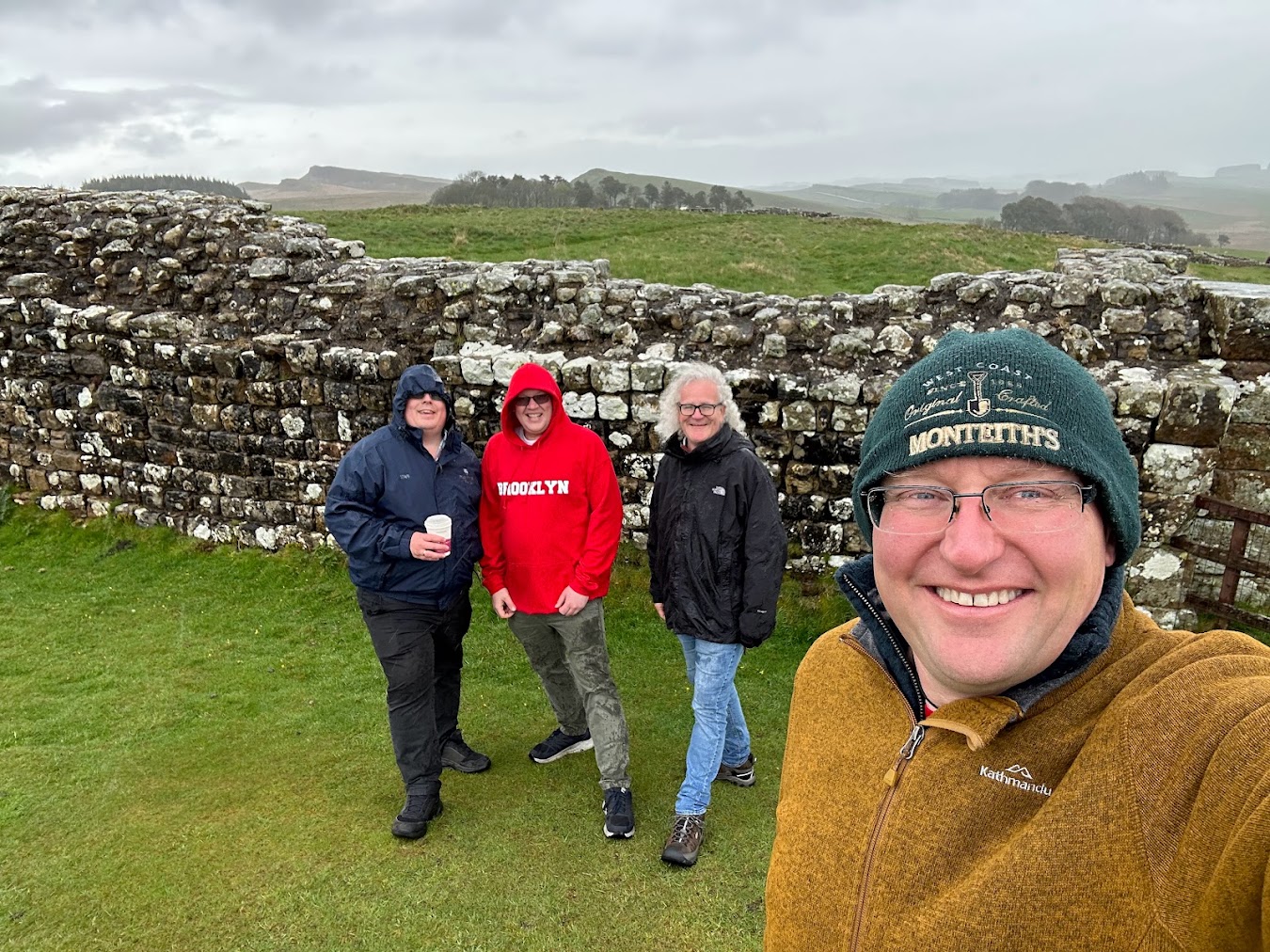
Our arrival was accompanied by cold air, persistent rain and strong winds.

It was not ideal sightseeing weather, but the conditions gave the landscape a suitably rugged atmosphere. Wrapped in coats and layers, we stepped out to explore the remains and take in the views.

The wall crossed the countryside ahead of us, its weathered stonework surrounded by open fields and rolling hills. Even beneath grey skies, it was easy to appreciate the scale of the undertaking and the history embedded in the landscape.

Coffee with Neil and Naomi

Hadrian’s Wall also provided the meeting point for a brief reunion with our friends Neil and Naomi.

A warm coffee was particularly welcome after our encounter with the Cumbrian weather. We caught up, exchanged news and enjoyed the slightly improbable pleasure of meeting friends beside one of Britain’s most significant Roman landmarks during a journey to Scotland.

It was only a short stop, but it added another memorable moment to the day.

Eventually, we said goodbye, returned to the warmth of the car and resumed our journey north.

Crossing into Scotland

With Hadrian’s Wall behind us, the focus returned to reaching Glasgow.

The weather remained changeable as Chris guided us along the final stretch. Conversation became quieter, the playlist continued and the accumulated miles gradually began to make themselves felt.

Even so, crossing into Scotland brought a renewed sense of excitement. Our canal holiday was no longer an idea discussed in London; it was waiting for us just beyond Glasgow.

By the time the city appeared, we were ready for a proper meal, comfortable beds and a rest from the road.

An evening in Glasgow

Our overnight base was the DoubleTree by Hilton in Glasgow.

After the early start, many hours in the car and our wet visit to Hadrian’s Wall, the hotel offered exactly what we needed. We checked in, unloaded the luggage and finally allowed ourselves to relax.

Tomorrow would bring a very different form of transport.

We would travel to Falkirk, collect our narrowboat and begin exploring the remarkable waterways linking Glasgow and Edinburgh. The road journey would give way to locks, aqueducts and canal cruising—with the Falkirk Wheel waiting near the beginning of our route.

The adventure before the adventure

Our drive from London to Glasgow could have been treated simply as the practical journey required to reach the boat.

Instead, good company, Jeff’s music, dramatic scenery and a rain-soaked encounter with Hadrian’s Wall made it a memorable part of the holiday.

The day carried us from our former home at the Royal Arsenal to the edge of Scotland’s canal network, passing one of Britain’s most extraordinary ancient landmarks along the way.

By bedtime, we were tired but excited. The bags were packed, the journey north was complete and our Scottish waterways adventure was about to begin.

Next stop: Falkirk.