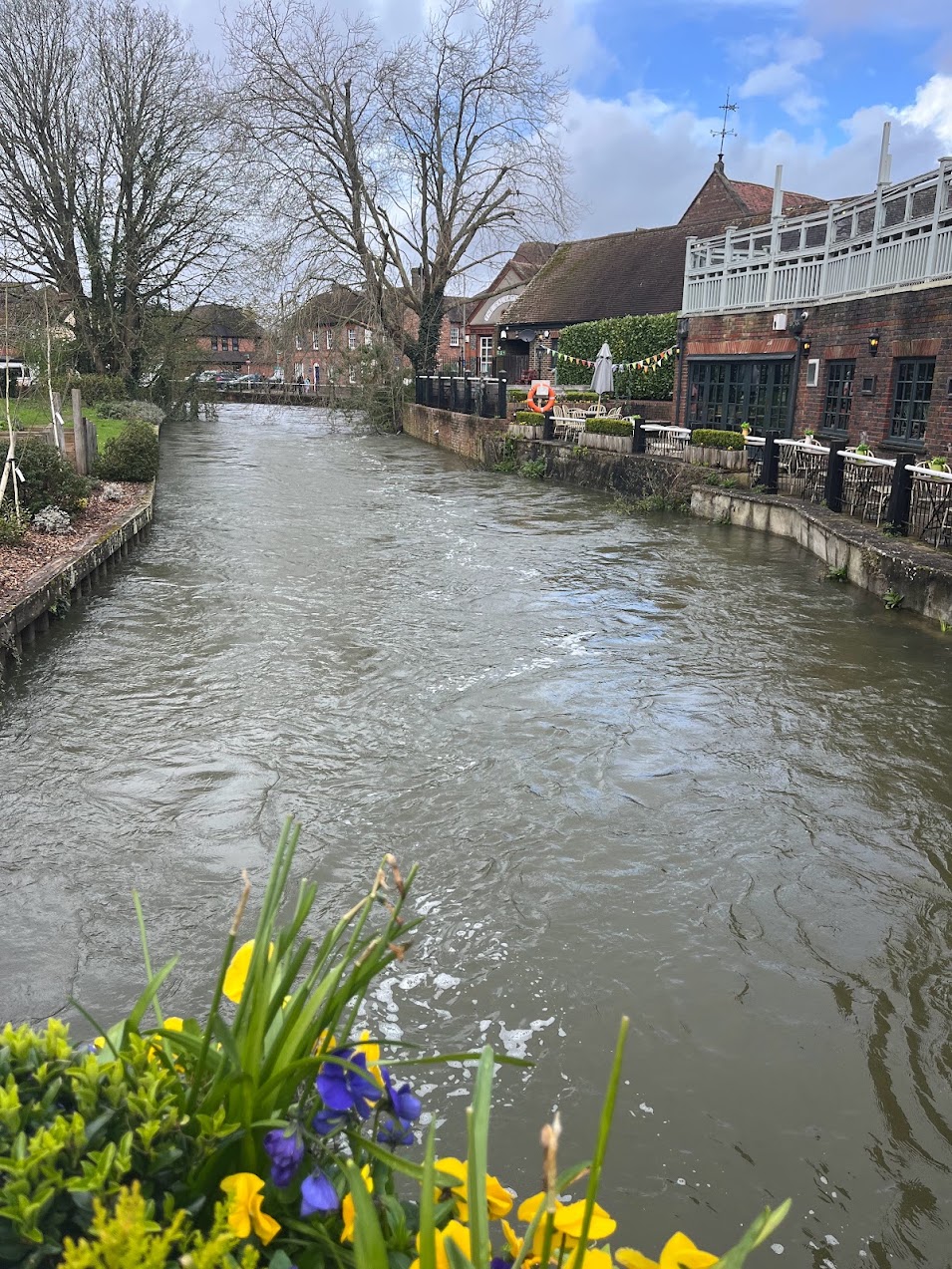
Our journey aboard Neil and Naomi’s narrowboat, Tilly Mint, from Hungerford to Newbury should have been a peaceful cruise along the Kennet & Avon Canal.
Instead, persistent rain, unusually strong flows and one frightening attempt to moor turned it into the closest we had ever come to losing control of the boat—and possibly sinking her.
Leaving Hungerford in difficult conditions
The weather had been poor, with recent heavy rainfall raising water levels and strengthening the flow along the canalised sections of the route.
We knew conditions were more challenging than usual, but the journey began without incident. Despite the drizzle, the Kennet & Avon remained beautiful: green countryside, trees leaning over the water and the familiar rhythm of locks carrying us towards Newbury.
The stronger flow demanded more concentration at bridges, bends and lock approaches, but we continued making steady progress.
As the day drew to a close, we began looking forward to securing Tilly Mint and settling down for the evening. We thought the most demanding part of the journey was behind us.
We were wrong.
The current takes control
As we attempted to moor in Newbury, the current caught Tilly Mint before we could bring her safely alongside the bank.
Within moments, the boat was being pushed sideways across the navigation. One end became trapped against the bank while the other was forced towards a moored boat on the opposite side.
We were wedged across the canal.
Normally, a narrowboat responds slowly but predictably. This time, the force of the moving water was greater than the control available from the engine and tiller. Every attempt to correct the boat’s position seemed to make another part of the situation worse.
The canal was no longer the calm, sheltered waterway we knew. It had taken control of the boat—and us.
Fifteen frightening minutes
For approximately 15 minutes, we struggled to free Tilly Mint.
The current continued pressing against the side of the hull, pinning the boat more firmly in place. The engine could provide power, but there was little room to manoeuvre and no safe angle from which to escape.
As the boat remained trapped awkwardly across the flow, the situation became genuinely frightening. A narrowboat caught against a strong current can begin to list, allowing water to reach openings that would ordinarily remain safely above the surface.
We became increasingly concerned that water might enter the boat. What had begun as a difficult mooring attempt now carried the very real possibility of serious damage—or worse.
Help arrives from the towpath
Thankfully, people nearby quickly recognised that we were in trouble.
Five members of the public came to help, taking hold of ropes and adding the strength we desperately needed from the bank. Their assistance gave us something the engine alone could not: the ability to control the boat from several directions at once.
Working together, we gradually changed Tilly Mint’s angle against the current. It was not a quick or graceful manoeuvre, but centimetre by centimetre the boat began to move.
Eventually, she came free.
With the helpers controlling the ropes from the towpath and those aboard managing the engine and tiller, we finally brought Tilly Mint safely alongside the bank.
The ropes were secured, the engine was stopped and, for the first time in what felt considerably longer than 15 minutes, we could breathe properly.
The kindness of strangers
Our overwhelming feeling was relief—but also gratitude.
The five people who stopped to help had no obligation to become involved. They saw a boat and its crew in difficulty and responded immediately.
Without them, freeing Tilly Mint against the force of the water would have been considerably harder and the outcome could have been very different.
Their kindness transformed a frightening situation into a powerful reminder of the community surrounding Britain’s waterways. When something goes wrong, assistance often comes from people who were strangers only moments earlier.
Respecting the water
The experience changed how we thought about boating in poor conditions.
Canals can appear gentle and predictable, particularly during calm weather. However, many sections interact with rivers, weirs, sluices and changing water levels. After prolonged rainfall, familiar stretches can behave very differently.
A heavy narrowboat may feel reassuringly solid, but it remains vulnerable when caught broadside by moving water. Once the flow takes control, the weight and momentum of the boat can make recovery extremely difficult.
Conditions must always be treated with respect, particularly when approaching locks, bridges, bends and moorings where space is limited.
Lessons from a narrow escape
Once Tilly Mint was safely secured, we could begin reflecting upon what had happened.
The experience reinforced several important lessons:
- Check water conditions and warnings before setting out.
- Allow considerably more room and time when manoeuvring in a strong flow.
- Prepare ropes early and agree clearly who will do what.
- Avoid becoming trapped broadside to moving water.
- Never hesitate to accept—or call for—help.
- If conditions feel unsafe, stopping early is better than pressing ahead.
Most importantly, never underestimate the power of water simply because it happens to be flowing through a canal.
An adventure we will never forget
Our cruise from Hungerford to Newbury became one of the most dramatic journeys we had experienced aboard Tilly Mint.
There was no triumphant arrival or elegant mooring—just an exhausted crew, a securely tied boat and enormous relief that everyone was safe.
It may become a story we can laugh about with the benefit of hindsight, but we will never forget the fear of being pinned across the canal or the sight of strangers rushing forward to help us.
Canal boating brings freedom, tranquillity and wonderful adventures. Occasionally, it also provides a sharp reminder that the waterways deserve our complete respect.
That day, teamwork and the kindness of five strangers prevented our narrow escape from becoming something much more serious.