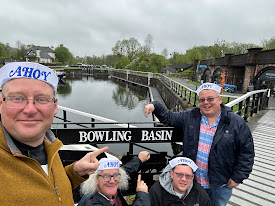
At the western end of the Forth & Clyde Canal lies Bowling Basin, where the sheltered inland waterway meets the broad tidal waters of the River Clyde.
Once a busy industrial harbour, the basin has been transformed into an attractive destination for walkers, cyclists and visitors. Its railway heritage, regenerated arches and expansive views make it a fascinating place to explore—but we could not help feeling that it deserves to welcome many more visitors by water.
Reaching the western end of the canal
After our Scottish waterways holiday, we visited Bowling Basin to see where the Forth & Clyde Canal completes its journey west.
The canal stretches across central Scotland, linking the Clyde with the Forth and creating a navigable route between the country’s east and west coasts. Bowling therefore feels like more than simply another canal basin: it is the threshold between inland cruising and considerably more adventurous tidal waters.
Standing beside the basin, we could look beyond the protective sea lock towards the Clyde and enjoy those wonderful views “doon the watter”.
A harbour shaped by industry
Bowling Basin was once a thriving centre of trade, boatbuilding and industry.
Canal boats brought goods westwards to meet vessels using the Clyde, while the surrounding railways connected the harbour with Scotland’s expanding industrial network. The surviving railway arches, disused tracks and swing bridge all provide reminders of the basin’s working past.
Although the commercial traffic has largely disappeared, its history remains clearly visible. This is not a heritage site preserved behind barriers; it is a landscape that has been adapted and given a new purpose.
A railway transformed
One of Bowling Basin’s most distinctive features is its former railway infrastructure.
The abandoned tracks and striking swing railway bridge have been incorporated into a linear park, allowing visitors to walk through parts of the site that were once dominated by industry. The old railway arches have also been restored and repurposed for small businesses and visitor facilities.
The result is an atmospheric mixture of canal, harbour and railway heritage. Rusting metalwork and old stone structures sit alongside improved paths, landscaped areas and modern activity.
It is regeneration that respects the site’s character rather than attempting to erase it.
Views “doon the watter”
The views from Bowling are tremendous.
Looking west, the Clyde opens towards Dumbarton and the distant hills, creating a dramatic contrast with the narrow, sheltered canal behind. The broad water and changing light give the basin an atmosphere unlike anywhere else along the Forth & Clyde Canal.
It feels simultaneously like the end of one journey and the beginning of another.
For generations of Glaswegians, travelling “doon the watter” meant heading along the Clyde towards the coastal resorts and holiday towns beyond. Standing at Bowling, it was easy to understand the enduring pull of that journey.
A destination deserving more boats
The regeneration work has helped establish Bowling Basin as a popular destination for walkers, cyclists and day visitors.
However, we would love to see more people arriving in the way that feels most appropriate: by boat.
More visiting boats would bring additional life and activity to the basin while strengthening its connection with the wider canal network. It could become a natural destination for boaters travelling west along the Forth & Clyde Canal, rather than simply somewhere to reach, turn around and leave.
With its history, views and restored surroundings, Bowling has all the ingredients needed to become one of Scotland’s most memorable waterways destinations.
Where canal, river and history meet
Our visit to Bowling Basin offered a fitting conclusion to our exploration of the Forth & Clyde Canal.
From the Falkirk Wheel and the journey into Glasgow to the open views across the Clyde, the canal had revealed engineering, industrial heritage and extraordinary contrasts throughout its length.
Bowling brings all those elements together. It is a canal terminus, a former industrial harbour, a regenerated public space and a gateway to the Clyde.
Most importantly, it is a place with enormous potential—both as a destination on land and as somewhere that could once again come alive with boats.