Long before Priscilla, Queen of the Canal became our dream, Chris and I were already finding our happiest moments beside the water.
One of our earliest adventures together was an urban75 walk along the London Loop near Richmond. What should have been a straightforward autumn walk became considerably more memorable when the Thames burst its banks—and my choice of trainers proved spectacularly inadequate.
Fortunately, Chris had both walking boots and a solution.
Exploring the London Loop
The London Loop circles the edge of Greater London, linking parks, woodland, riversides and historic settlements into one remarkably varied walking route.
It can take you from busy suburban streets into peaceful countryside within minutes. On this particular section near Richmond, the Thames provided a beautiful backdrop to the walk—and, as we soon discovered, an unexpected obstacle.
Chris and I set out looking forward to a relaxed day of walking with the urban75 group. We had already enjoyed several adventures together, but were still at the beginning of the much longer journey our lives would eventually take.
I had arrived wearing trainers, confidently assuming that the paths would be reasonably firm and well maintained. Chris had made the considerably wiser decision to wear proper walking boots.
That difference would shortly become important.
When the Thames joined the path
As we approached the river, it became clear that the Thames had burst its banks.
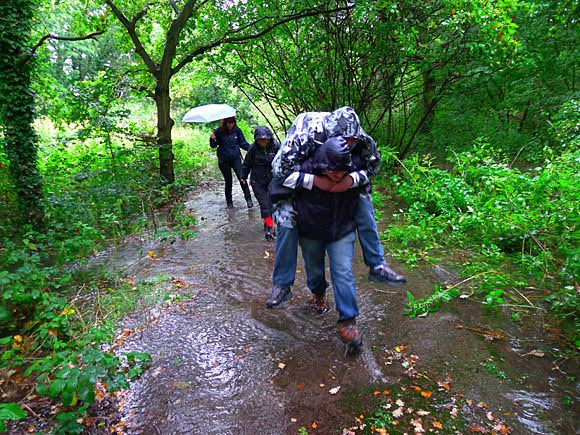
Water had spread across sections of the route, covering the path and turning an ordinary riverside walk into an improvised obstacle course. What had once been solid ground was now hidden beneath cold, murky water.
Some stretches could be negotiated by carefully stepping around the edges. Others offered no dry alternative at all.
Chris’s boots were sturdy enough to cope. My trainers most certainly were not.
They might have survived a shallow puddle, but they had not been designed for wading through the Thames. I was faced with the prospect of soaking wet feet for the remainder of the walk—or finding a more inventive way across.
The piggyback solution
Chris assessed the flooded path and proposed the only practical solution: I would have to climb onto his back.
It was hardly the dignified image of two capable outdoor adventurers, but it was considerably better than spending the rest of the day with trainers full of river water.
Laughing at the absurdity of the situation, I climbed aboard. Chris then carried me through the flooded section while carefully feeling for the submerged path beneath his boots.
For a brief moment, our peaceful walk had become a particularly low-budget river crossing expedition.
There was every possibility that Chris might slip, leaving both of us sitting in the Thames. Instead, he successfully delivered me to dry ground with my trainers—and dignity, just about—intact.
What could easily have become a frustrating interruption instead became the defining memory of the day.
An early adventure together
Looking back, the flooded path seems like a small incident. Yet it captured something important about our relationship even then.
We enjoyed being outdoors, exploring new places and spending time together. When plans changed, we adapted. When something went wrong, we usually found a way to laugh about it.
The day was not memorable because everything went perfectly. It stayed with us because it did not.
There was no need for a grand destination or meticulously planned experience. A walk beside the Thames, an unexpectedly flooded path and a piggyback were enough to create a story we would still be telling years later.
Drawn to the water
At the time, neither of us could have known how important Britain’s waterways would eventually become to us.
We were simply enjoying a walk beside the river. There was no carefully developed plan for a narrowboat, no Priscilla, Queen of the Canal and no vision of the boating adventures that would follow.
Yet, looking back, the clues were already there.
We loved the countryside, enjoyed travelling slowly and were repeatedly drawn towards rivers and canals. Most importantly, we loved experiencing those places together.
That walk on the London Loop now feels like a small but significant part of our waterways story: an early adventure in which the water refused to remain politely beside the path.
A glimpse of what lay ahead
Life rarely announces its important moments while they are happening.
That day near Richmond did not feel like the beginning of anything. It was simply an enjoyable walk with an unexpected complication—and a very funny solution.
Only with hindsight can we see how naturally it fits into the story that followed. Our shared love of walking, water and slightly chaotic adventures would eventually lead to narrowboat holidays, journeys across Britain’s canals and the dream of creating our own life afloat.
The flooded Thames did not reveal our future. But it may have offered a small glimpse of it.
And if our life together was always destined to involve unpredictable waterways, teamwork and occasional indignity, that piggyback was excellent preparation.