Posted on

Day 5: The Long Cruise from Bram to Trèbes

After negotiating 18 locks on our first afternoon aboard, we might reasonably have planned a gentle second day.

Instead, we faced the longest cruise of the holiday: approximately 36 kilometres from Bram to Trèbes, with another 13 locks along the way.

It would demand around seven and a half hours on the water—and provide a wonderful opportunity to settle into the rhythm of the Canal du Midi.

An early departure from Bram

We left Bram knowing that we had a considerable distance to cover.

Yesterday’s intensive introduction had at least made us more confident with the boat. The controls no longer felt entirely unfamiliar, and we had begun to establish a routine for approaching locks, handling ropes and sharing the work.

Nevertheless, 36 kilometres represented an ambitious day by canal standards.

The engine started, the ropes were released and Bram’s quiet port gradually disappeared behind us.

Finding our cruising rhythm

The previous afternoon had been dominated by locks. Today brought longer stretches of uninterrupted cruising, giving us more time to appreciate the canal itself.

The Canal du Midi wound through the countryside beneath avenues of trees, passing vineyards, fields and small settlements. In places, the waterway seemed almost enclosed by the landscape; elsewhere, the views opened across the Aude countryside.

Progress remained unhurried, but that is precisely the pleasure of travelling by boat.

At walking pace, details that would disappear from a car became part of the journey: reflections beneath stone bridges, people passing on the towpath and the constantly changing patterns of sunlight across the water.

Another 13 locks

Although fewer than yesterday, 13 locks still required plenty of concentration.

By now, we were beginning to understand how the boat responded inside the Canal du Midi’s distinctive oval chambers. Each lock brought its own currents, awkward angles and opportunities for Chris and Adam to offer entirely different opinions about what should happen next.

Our technique was improving—even if our communication occasionally remained a work in progress.

The locks divided the long cruise into manageable stages. We would travel for a while, prepare the ropes, work through another chamber and then continue towards Trèbes.

Each successful passage carried us farther from Castelnaudary and closer to the Mediterranean.

A full day on the water

Seven and a half hours aboard sounds leisurely until it includes steering, locks, ropes and the sustained concentration required to handle an unfamiliar hire boat.

By the afternoon, the scale of the day was becoming apparent.

We had covered substantially more ground than yesterday, while still negotiating structures built as part of a canal more than three centuries old.

Tiredness was beginning to set in, but so was a growing sense of confidence. The Canal du Midi no longer felt like somewhere we had merely come to visit. For the duration of the holiday, it was becoming our route through southern France.

Arriving in Trèbes

The sight of Trèbes was especially welcome.

The town occupies an important position where the Canal du Midi meets the River Aude and the Orbiel. Its canalside port offered a lively contrast to the quieter rural stretches through which we had travelled.

After approximately 36 kilometres and 13 locks, we found our mooring and finally stopped the engine.

The silence that follows a long day’s cruising is one of boating’s simplest pleasures. After hours of engine noise and constant movement, arriving brings an immediate sense of stillness—and considerable satisfaction.

An evening beside the canal

With the boat secured, we could turn our attention to Trèbes.

The port is lined with places to eat and drink, making it an ideal stopping point after a demanding journey. Les Vignes de Bacchus offered the prospect of local wine, while Le Moulin de Trèbes provided a picturesque canalside setting.

Whichever table we chose, dinner felt thoroughly earned.

Over food and wine, we reflected upon how quickly the holiday had gathered momentum. In little more than a day, we had travelled from Castelnaudary to Trèbes and worked through 31 locks.

Our arms knew about every one of them.

A forced day of rest ahead

Tomorrow was 1 May—a public holiday in France.

With the lock keepers not working, we would remain in Trèbes for the day rather than continuing along the canal.

After two demanding cruises, this was far from an inconvenience. It offered time to explore the town, replenish our supplies and enjoy the boat without needing to move it.

For now, we were simply pleased to have reached Trèbes.

Our longest cruising day was complete, another 13 locks were behind us, and a welcome day of rest lay ahead.

Posted on

Day 4: Eighteen Locks to Bram

Our Canal du Midi adventure was finally under way—and it began with one of the most demanding days of the holiday.

The journey from Castelnaudary to Bram covered approximately 16 kilometres and required us to negotiate 18 locks. It was an energetic introduction to the canal, but also an opportunity to experience its remarkable seventeenth-century engineering at close quarters.

Leaving Le Grand Bassin

After completing the boat handover and stowing our supplies, we eased away from Le Grand Bassin in Castelnaudary.

The wide expanse of the basin soon narrowed into the Canal du Midi. Ahead lay around five and a half hours of cruising—and considerably more lock work than we would ordinarily choose for a relaxing first afternoon.

There was little time to settle gently into boating life. Almost immediately, we needed to establish our routine: approaching each lock, handling the ropes, keeping the boat under control and preparing to repeat the process a few hundred metres later.

Learning the locks

The locks of the Canal du Midi differ considerably from those we know on Britain’s waterways.

Many retain the distinctive oval chambers introduced during the canal’s original construction. Their curved walls were designed to withstand pressure more effectively, but they also create unusual currents as the chamber fills or empties.

Working through them required concentration and coordination.

As the afternoon progressed, we became more confident at positioning the boat, securing the ropes and anticipating the movement of the water. The first few locks felt like individual challenges; eventually, they became part of the rhythm of the journey.

Only another 17 to go.

Eighteen locks in one afternoon

There is no disguising the fact that 18 locks is a substantial undertaking—particularly on the first day aboard an unfamiliar boat.

Each lock interrupted our forward progress, but every one also formed part of the experience. We were travelling through structures conceived more than 350 years ago, following a route shaped by Pierre-Paul Riquet and generations of engineers, lock keepers and canal workers.

Between the locks, we passed through a landscape of fields, vineyards and tree-lined towpaths. The slower stretches gave us time to enjoy our surroundings before the next chamber appeared ahead.

The Canal du Midi was already proving that distance alone is a poor measure of a boating day. Sixteen kilometres may not sound far, but after 18 locks, it felt like a genuine achievement.

Arriving in Bram

Eventually, tired but increasingly comfortable with the boat, we reached Bram.

The canal port provided a welcome place to moor after our demanding first cruise. Once the engine stopped, the sudden quiet felt particularly satisfying.

Bram may appear to be a traditional village from the canal, but its historic centre has an unusual secret: it was constructed in a series of concentric circles.

The circular village of Bram

At the centre of Bram stands the church of Saint-Julien-et-Sainte-Basilisse. Streets and buildings radiate around it in an almost circular pattern, creating one of the finest examples of a circulade village in southern France.

These distinctive settlements developed during the medieval period, often with homes arranged defensively around a church or château.

Walking through Bram revealed the pattern gradually. Narrow streets curved around the centre rather than following a conventional grid, with each circuit drawing us closer to the historic heart of the village.

After spending the afternoon progressing in a straight line along the canal, exploring somewhere built entirely in circles seemed rather appropriate.

Wine and dinner beside the canal

A visit to Vineas Frogg wine merchant offered the opportunity to discover more of the wines produced across the surrounding region—and replenish our supplies after the exertions of the day.

We ended the evening near the canal at L’Île aux Oiseaux, reflecting upon our first journey aboard.

Only that morning, we had been collecting provisions and learning the boat’s controls. By evening, we had travelled 16 kilometres, negotiated 18 locks and reached our first overnight destination.

A demanding but memorable beginning

Our first cruise had given us an immediate introduction to the character of the Canal du Midi.

The locks demanded patience, teamwork and rapid familiarisation with an unfamiliar boat. In return, the journey offered historic engineering, beautiful countryside and the satisfaction of arriving somewhere new under our own power.

Tomorrow would bring an even longer cruise: approximately 36 kilometres from Bram to Trèbes, with another 13 locks along the way.

For now, however, we were content to remain in Bram, enjoy the stillness of the canal and celebrate surviving all 18.

Posted on

Day 3: Boarding Our Boat in Castelnaudary

After two days on the road and exploring Carcassonne, the moment we had been waiting for finally arrived: it was time to board our boat and begin our journey along the Canal du Midi.

We left Carcassonne, stocked up on provisions and drove to Castelnaudary, where our boat awaited us beside the vast waters of Le Grand Bassin.

Preparing for life aboard

Before reaching the marina, we stopped to buy everything needed for the journey ahead.

Planning meals for a boating holiday always involves striking a delicate balance. We needed enough food and wine to sustain us between villages, but everything still had to fit inside the boat’s relatively compact cupboards and refrigerator.

With the shopping completed—and considerably more supplies than two people could reasonably require—we continued towards Castelnaudary.

Arriving at Le Grand Bassin

Our starting point was Le Grand Bassin, an impressive expanse of water on the edge of Castelnaudary.

Created as part of the Canal du Midi, the basin once served as an important commercial port. Today, its broad waters provide a striking contrast to the narrow canal channels that would define much of our journey.

At 11.00 am, we arrived at the base, completed the formalities and were introduced to our temporary home.

After a boat handover, safety briefing and explanation of the controls, it was time to unpack. Bags disappeared into cabins, food filled the cupboards and bottles were carefully secured against the inevitable bumps ahead.

Just a Minute: the Canal du Midi

Construction of the Canal du Midi began in 1666 under the direction of Pierre-Paul Riquet.

Completed in 1681, it created a navigable route through southern France, connecting Toulouse with the Mediterranean. Together with the River Garonne and the Canal de Garonne, it helped establish an inland passage between the Atlantic and Mediterranean.

Its construction required an extraordinary network of locks, aqueducts, bridges and reservoirs. Riquet’s greatest challenge was supplying the canal with sufficient water—a problem addressed through an innovative system drawing water from the Montagne Noire.

The Canal du Midi became a UNESCO World Heritage Site in 1996. Our holiday therefore took place during the thirtieth anniversary year of that recognition.

One minute—and more than three centuries of remarkable engineering.

Learning a new boat

However experienced you may be on the water, every hire boat behaves differently.

The steering responds differently, the engine has its own character and stopping distances are generally discovered through a mixture of instruction, judgement and mild alarm.

We familiarised ourselves with the controls and checked the equipment before preparing to leave Le Grand Bassin.

Ahead of us lay an ambitious first cruise: approximately 16 kilometres from Castelnaudary to Bram, taking around five and a half hours and passing through 18 locks.

It was certainly not the gentlest possible introduction.

Leaving Castelnaudary

With everything aboard, we started the engine and eased away from the base.

Months of research, route planning and anticipation had finally become real. We were no longer merely discussing a Canal du Midi holiday—we were navigating it.

The broad waters of Le Grand Bassin gradually gave way to the canal itself. Plane trees, towpaths and the landscape of southern France surrounded us as Castelnaudary began to disappear behind the boat.

There was little time to become sentimental.

Our first lock—and another 17 after it—was waiting.

Posted on

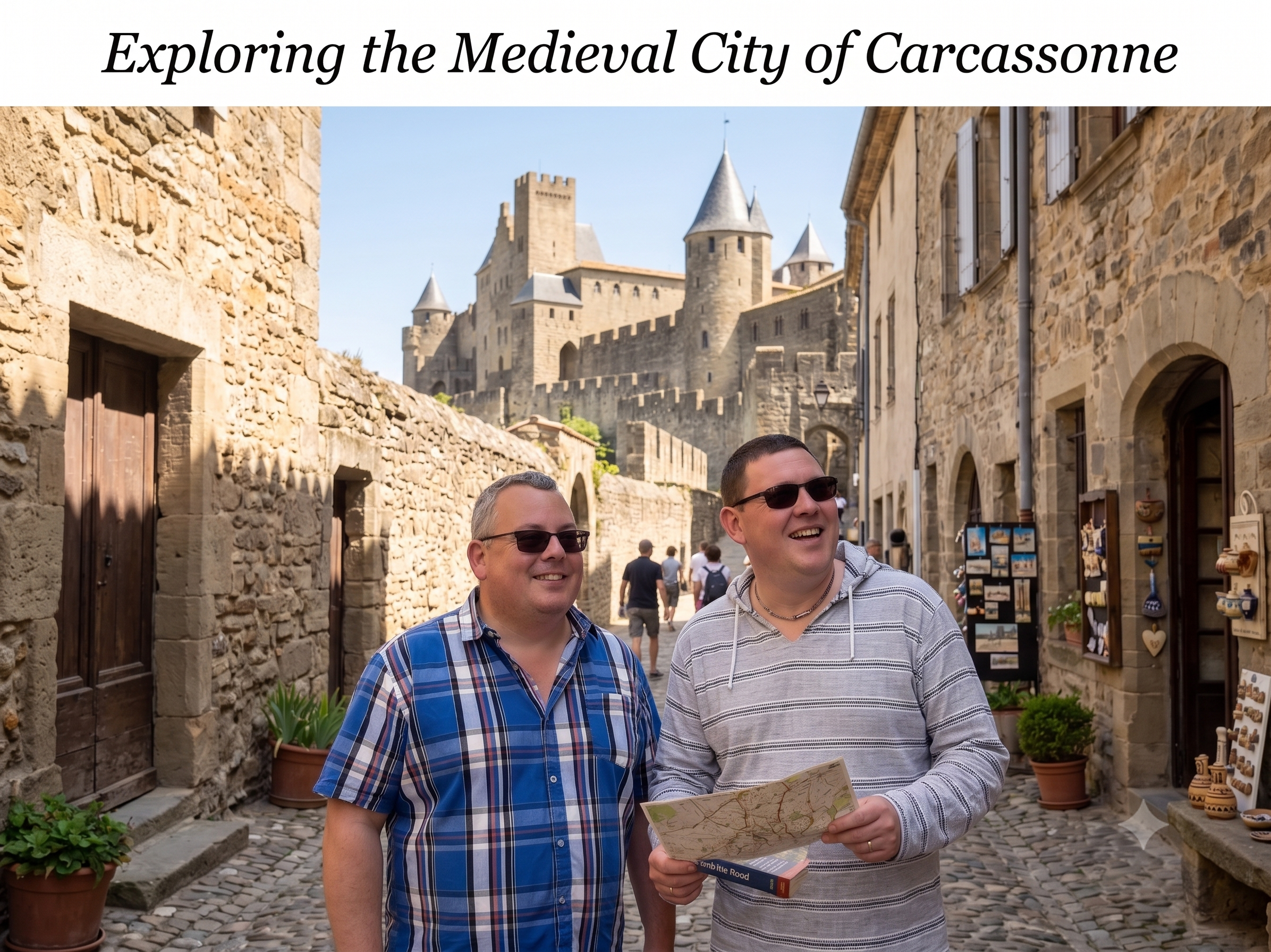
Day 2: Exploring the Medieval City of Carcassonne

After yesterday’s 700-mile drive across France—and our rather frantic 3.50 am awakening—we had earned a slower start.

A welcome lie-in was followed by a day exploring Carcassonne: walking its ancient ramparts, discovering the Château Comtal and experiencing one of Europe’s most remarkable fortified cities.

A much-needed slower morning

There was no alarm dragging us from bed at an unreasonable hour and, more importantly, no deadline involving an international train.

Our Airbnb, just outside Carcassonne’s walls, provided the perfect base for the day. After recovering from the long journey south, we set out to explore the medieval city we had glimpsed on arrival.

Known locally as La Cité, the fortified city rises dramatically above the River Aude. Its double walls, numerous towers and pointed rooftops create the appearance of a storybook castle—although its history is considerably more complicated than any fairy tale.

Walking around the ramparts

Our exploration began with a walk of approximately two miles around the fortifications.

The scale of Carcassonne is difficult to appreciate until you stand beneath its walls. Tower after tower stretches around the hilltop, creating an extraordinary defensive enclosure that has protected the settlement in various forms for centuries.

From the ramparts, we could look across the terracotta rooftops towards the surrounding countryside. The landscape felt very different from the one we had left behind in northern France the previous morning.

Walking slowly also gave us time to notice the many layers of the city’s architecture. Roman foundations, medieval defences and nineteenth-century restoration all contribute to the Carcassonne seen today.

Just a Minute: Carcassonne

Carcassonne’s story began long before the Middle Ages, with Roman fortifications constructed around the settlement.

The Visigoths strengthened the city during the fifth century, and its defences were expanded considerably during the medieval period. The powerful Trencavel family developed the Château Comtal during the twelfth century before Carcassonne came under the control of the French Crown.

By the nineteenth century, parts of the fortifications faced demolition. Architect Eugène Viollet-le-Duc instead led an extensive—and sometimes controversial—restoration that created much of the city’s distinctive modern appearance.

In 1997, the Historic Fortified City of Carcassonne was inscribed as a UNESCO World Heritage Site.

One minute—and more than 1,500 years of history.

Inside the Château Comtal

At the heart of the fortified city stands the Château Comtal, once the stronghold of Carcassonne’s medieval rulers.

Exploring the castle brought us inside the defensive walls and offered a closer view of their construction. Courtyards, towers, stone passageways and elevated walkways revealed how carefully the fortress had been designed.

The château was not simply an impressive residence. It formed another defensive stronghold within the already fortified city, providing additional protection for those who controlled Carcassonne.

From its walls, we enjoyed impressive views across La Cité and the modern city beyond.

Beyond the fortifications

Carcassonne is more than its walls and castle.

Inside the fortifications, narrow streets weave between shops, restaurants and historic buildings. Although the city attracts visitors from around the world, it remains possible to imagine the generations who once lived, worked and sought shelter within these walls.

We spent the afternoon exploring at a relaxed pace, stopping whenever something caught our attention and enjoying the freedom of having nowhere else to be.

After yesterday’s relentless motorways, travelling two miles on foot felt wonderfully civilised.

Dinner at Le Jardin de l’Estagnol

At 7.00 pm, we finished the day with dinner at Le Jardin de l’Estagnol.

It was an opportunity to relax, enjoy our first proper evening in southern France and reflect upon everything we had seen.

Carcassonne had provided an extraordinary opening to the holiday. Its walls connected Roman, Visigothic and medieval history, while its restoration demonstrated how easily such heritage might have been lost.

Tomorrow, the Canal du Midi

The following morning, we would leave Carcassonne and travel to Castelnaudary, stopping for supplies before boarding our boat at Le Grand Bassin.

After months of planning, our Canal du Midi journey was almost ready to begin.

For now, however, Carcassonne had given us exactly what we needed: a slower day, a remarkable walk through history and an evening spent anticipating the adventure ahead.

Posted on

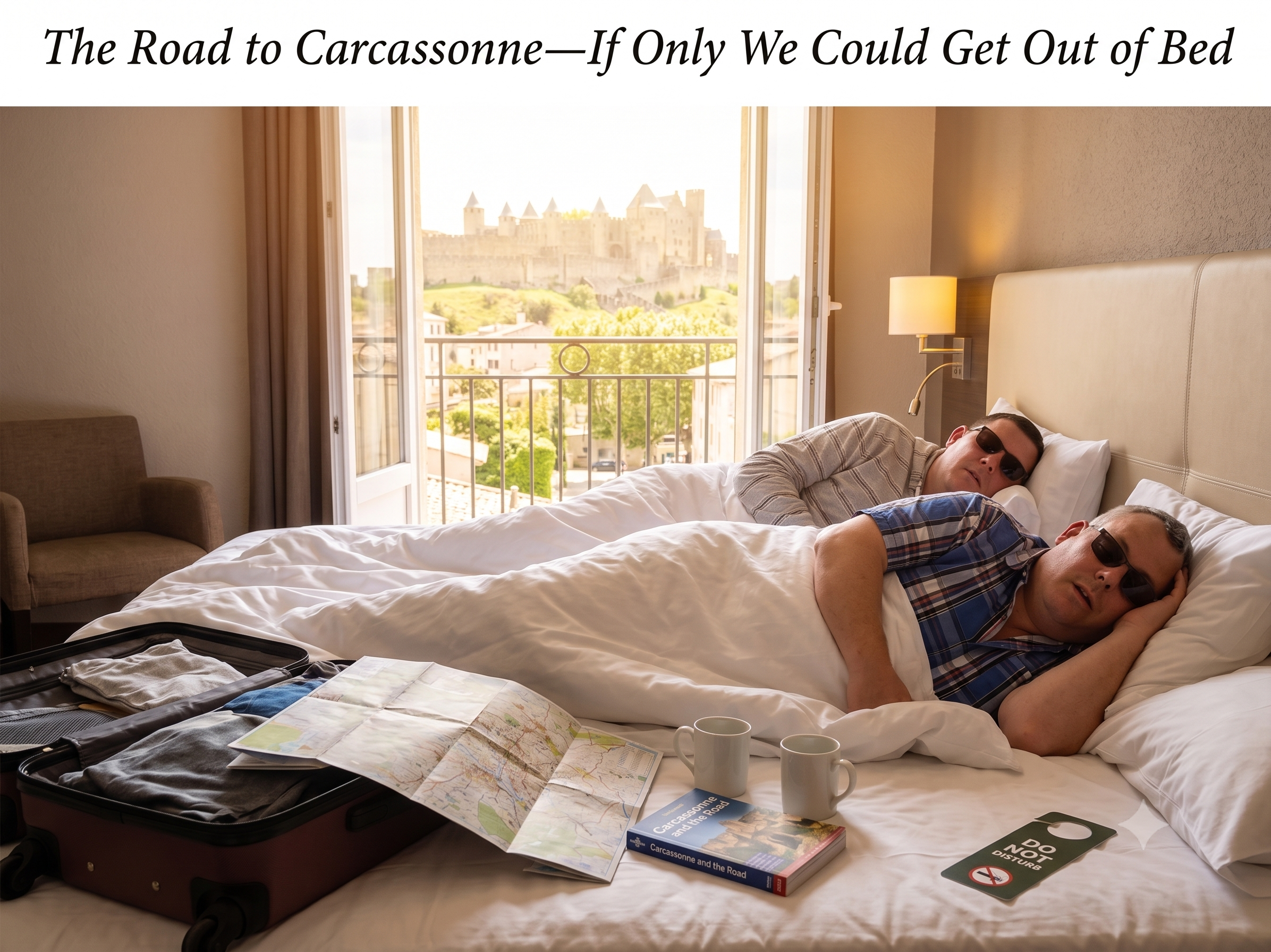
Day 1: The Road to Carcassonne—If Only We Could Get Out of Bed

Every great adventure begins somewhere.

Ours began at 3.50 am, when Chris and Adam woke to discover that they had overslept for a planned 4.00 am departure.

After months of preparation, carefully calculated timings and detailed holiday planning, we had allowed ourselves precisely ten minutes to get out of bed, load the final bags and begin driving to France.

It was an impressively chaotic start to our Canal du Midi adventure.

Ten minutes to departure

The alarm—or our response to it—had not gone entirely according to plan.

Our intention had been to leave home at 4.00 am, giving us ample time to reach Folkestone for our 6.20 am LeShuttle crossing.

Instead, we woke ten minutes before departure.

What followed was less a calm beginning to the holiday and more a hastily choreographed evacuation. Clothes were pulled on, bags were checked and anything not already packed immediately became somebody else’s problem.

Somehow, we got on the road.

Crossing to France

With the first crisis narrowly behind us, we reached Folkestone and boarded LeShuttle for the short journey beneath the English Channel.

The crossing marked the real beginning of our holiday. Britain disappeared behind us and, within approximately 35 minutes, we emerged in Calais with an enormous drive still ahead.

Our destination was Carcassonne—around 700 miles away in southern France.

Calais to Carcassonne

Leaving Calais at approximately 7.55 am, we began the long journey south.

The drive would take around 12 hours, carrying us almost the entire length of France. It was a demanding way to begin a holiday, but it allowed us to bring everything needed for more than a week aboard—including, inevitably, considerably more than we were ever likely to use.

Motorways replaced canals for the day as we travelled from northern France towards Occitanie.

The landscape gradually changed around us. The flatter scenery of the north gave way to the warmer colours and increasingly distinctive character of southern France.

Every mile brought us closer to Carcassonne—and to the Canal du Midi.

Our first sight of Carcassonne

After a journey of approximately 700 miles, reaching Carcassonne brought an enormous sense of relief.

The medieval fortified city dominates the surrounding landscape, with its walls, towers and hilltop position creating one of the most recognisable views in France.

Our Airbnb was situated just outside the city walls, placing us within easy reach of the historic centre while giving us somewhere comfortable to recover from the drive.

After beginning the day in a ten-minute panic and spending most of it crossing France, we had finally arrived.

The adventure begins

Tomorrow would be devoted to exploring Carcassonne properly.

For tonight, simply reaching it felt like an achievement.

The Canal du Midi was waiting, our boat would be ready in Castelnaudary in two days, and more than a week of locks, villages, vineyards and waterways lay ahead.

Our journey may not have started with exemplary timekeeping, but the adventure was now firmly under way.

Posted on

Southampton Boat Show: Looking Beyond the Narrowboat World

The Southampton International Boat Show is not an obvious destination for two committed narrowboat enthusiasts.

Its pontoons are filled with sailing yachts, motor cruisers and sea-going craft designed for very different waters from those Priscilla will eventually navigate. Yet, on Saturday 27 September, we attended with our dear friends Ian and Dave—and discovered that looking beyond the inland waterways can be enormously valuable.

This was the fourth and final boat show of our year. We were not there to choose a yacht or study offshore performance. We went in search of ideas that might influence the design of our future home afloat.

As we plan Priscilla, we want to preserve the character and warmth associated with a traditional narrowboat while introducing contemporary design, intelligent technology and a greater sense of space. Southampton offered an opportunity to see how the wider marine industry approaches those same challenges.

Why visit a sea-going boat show?

Narrowboats and yachts operate in very different environments, but they share a fundamental design problem: fitting everything required for comfortable living into a long, constrained space.

Marine designers must accommodate storage, services, machinery, seating, sleeping areas and practical circulation without making the interior feel overcrowded. Equipment must remain secure while underway, materials must tolerate moisture and every available space needs to work hard.

The scale and cost of many boats at Southampton may bear little resemblance to our project, but the underlying design principles remain relevant.

We were particularly interested in:

  • Interior layouts and visual continuity
  • Compact furniture and convertible spaces
  • Concealed storage
  • Lighting and material choices
  • Workspaces suitable for extended use
  • Energy and electrical systems
  • Equipment accessibility
  • Outdoor social spaces
  • The boundary between attractive design and practical operation

The aim was not to reproduce a yacht interior inside a narrowboat. It was to identify ideas that could be adapted intelligently to Priscilla’s dimensions, cruising environment and intended use.

Creating a sense of space

One of the most useful lessons was how strongly an interior can be influenced by sightlines.

Many of the boats used consistent flooring, repeated materials and carefully aligned furniture to make the accommodation appear longer and less fragmented. Pale finishes reflected natural light, while darker timber or coloured panels were used selectively to add warmth and definition.

This reinforced our preference for an interior that feels cohesive rather than divided into a sequence of unrelated rooms.

Priscilla will need distinct areas for cooking, relaxing, working, washing and sleeping, but we do not want every function enclosed behind a solid partition. Carefully positioned openings, changes in lighting and subtle variations in material could distinguish spaces without making the boat feel smaller.

Mirrors and reflective surfaces were also used effectively, although these need restraint. A narrowboat interior filled with glossy finishes could feel artificial and would show fingerprints, marks and imperfections very quickly.

The strongest designs created spaciousness through proportion and simplicity—not decoration alone.

Modern design without losing warmth

Contemporary marine interiors sometimes appear stark, particularly when dominated by white laminates, polished surfaces and cool lighting.

That is not the atmosphere we want aboard Priscilla.

Our aim remains a classic narrowboat with a modern twist: an interior that acknowledges the heritage of the waterways while avoiding an overly traditional or visually heavy appearance.

Southampton demonstrated how this balance might be achieved through:

  • Natural or convincingly textured timber finishes
  • Simple cabinetry with carefully considered details
  • Warm, layered lighting
  • Upholstery that introduces colour and personality
  • Contrasting materials used sparingly
  • Rounded corners and softened edges
  • High-quality handles, hinges and fittings
  • A limited and consistent interior palette

The lesson was not that luxury requires extravagant materials. It often comes from consistency, proportion, tactile quality and attention to small details.

Priscilla should feel distinctive and full of personality, but the permanent structure must remain sufficiently calm to support changing furnishings, artwork and possessions over many years.

Storage designed into the boat

Yacht designers are particularly accomplished at finding storage in places that might otherwise be wasted.

We saw drawers beneath seating, compartments inside steps, shallow lockers built into wall panels and beds surrounded by carefully planned cupboards. Some solutions were almost invisible until opened.

This is highly relevant to full-time narrowboat living. Storage cannot simply be added after the layout has been designed; it must be considered as part of the structure from the beginning.

Priscilla will need accessible homes for:

  • Clothing and footwear
  • Bedding and towels
  • Food and kitchen equipment
  • Filming and photographic equipment
  • Tools and spare parts
  • Cleaning materials
  • Outdoor clothing
  • Folding furniture
  • Mooring equipment
  • Documents and personal belongings
  • Technology and charging equipment

Capacity alone is not enough. Heavy items must be stored low and securely, frequently used belongings must remain easy to reach, and technical equipment cannot be buried behind possessions.

A locker is only useful if it can be opened without moving half the furniture first.

We also need to avoid filling every concealed void. Some areas will be required for ventilation, pipes, cables, inspection and future maintenance. The design must clearly distinguish usable storage from essential technical space.

A proper place to work

We expect to spend extended periods aboard Priscilla, so the ability to work comfortably will be important.

Several boats demonstrated that a useful desk does not necessarily require a separate office. Compact work surfaces were incorporated into cabins, shelving units and seating areas, sometimes with monitors or equipment concealed when not in use.

For Priscilla, the workspace should provide:

  • A comfortable seated position
  • Sufficient depth for a laptop and monitor
  • Adjustable task lighting
  • Accessible power and data connections
  • Ventilation around electronic equipment
  • Storage for stationery and accessories
  • Space for video editing
  • A background suitable for calls and filming
  • The ability to put work away at the end of the day

A dining table that occasionally accommodates a laptop may not be sufficient for regular work. Equally, a permanent desk that dominates the saloon would use valuable living space.

A carefully designed convertible or partially concealed workspace may provide the best compromise.

Lighting as part of the architecture

Lighting was one of the clearest differences between the strongest and weakest interiors.

The most successful boats did not rely upon a single row of bright ceiling lights. Instead, they combined several layers:

  • General background illumination
  • Task lighting for cooking and working
  • Reading lights
  • Low-level evening lighting
  • Concealed accent lighting
  • Courtesy lighting near steps and floor edges
  • Exterior lighting for safe boarding

This approach could help Priscilla change character throughout the day.

Bright, accurate lighting will be needed for cooking, cleaning and working. Softer lighting can create a relaxed atmosphere in the evening, while very low-level illumination could allow movement through the boat at night without disturbing the other person.

The colour temperature and quality of the light matter as much as the fittings themselves. Poorly selected LEDs can make timber, fabrics and skin tones appear unnatural.

Lighting must also remain energy-conscious, independently controllable and repairable. Decorative fittings should not create a dependence upon proprietary components that may become unavailable.

Materials suitable for real life

Boat-show interiors are presented in immaculate condition, usually without wet coats, muddy footwear, shopping bags or the accumulated belongings of everyday life.

Priscilla’s materials must cope with reality.

Surfaces should be:

  • Resistant to moisture and temperature changes
  • Easy to clean
  • Durable around frequently touched areas
  • Repairable where possible
  • Secure under vibration and movement
  • Appropriate for their fire-safety role
  • Light enough for the overall weight plan
  • Stable in a marine environment
  • Comfortable rather than merely photogenic

Highly polished surfaces may look impressive under exhibition lighting but prove less successful after years of use. Similarly, pale upholstery can make a cabin feel spacious but may require removable, washable covers.

The most suitable choices will balance appearance, durability, weight, maintenance and environmental impact.

Energy and electrical ideas

The show also provided an opportunity to examine developments in marine energy systems.

Solar generation, lithium batteries, inverters, intelligent monitoring and hybrid propulsion are increasingly visible across the boating industry. Many sea-going vessels face the same desire to operate quietly and independently without running an engine solely to produce electricity.

For Priscilla, the important lesson is that individual technologies cannot be considered in isolation.

Battery capacity, propulsion, heating, hot water, cooking, laundry, communications and domestic equipment will all compete for the same stored energy. Installing more electrical equipment without modelling how it will be used could create an impressive specification that performs poorly in practice.

We therefore need to consider:

  • Realistic daily and seasonal energy consumption
  • Solar output during winter as well as summer
  • Charging while cruising
  • Shore-power limitations
  • Battery reserve for propulsion
  • Inverter capacity and simultaneous loads
  • Redundancy and emergency operation
  • Cooling and ventilation for electrical equipment
  • Monitoring that occupants can understand
  • Safe isolation and maintenance access
  • The future replacement of rapidly developing technology

Southampton offered inspiration, but it also reinforced the importance of disciplined system design.

Technology should remain serviceable

Large yachts often contain sophisticated integrated systems controlling lighting, climate, entertainment, navigation and security.

Priscilla may eventually use similar automation on a smaller scale. However, integration creates potential dependencies.

We do not want a failed central screen, network controller or proprietary application to prevent us from switching on a light, operating a pump or adjusting the heating.

The design should combine intelligent monitoring with straightforward local control. Essential systems must remain understandable, manually operable and capable of functioning when internet access or central automation is unavailable.

Cables, sensors and communications equipment will also need planned routes and accessible replacement points. Technology ages more quickly than a boat’s structure, so equipment should be capable of being upgraded without dismantling the interior.

Learning from outdoor spaces

The exterior living areas of the boats also gave us ideas.

Yachts frequently treat the cockpit or aft deck as another room, with sociable seating, practical tables, integrated lighting and protection from the weather. Although a narrowboat stern is much smaller and subject to different constraints, it should still be designed as a purposeful social space.

Priscilla’s stern will need to balance:

  • Safe control of the boat
  • Clear access for the steerer
  • Comfortable seating
  • Secure boarding
  • Mooring operations
  • Storage
  • Protection from rain and sun
  • Visibility
  • Access to technical equipment
  • Space for conversation while cruising

It must work first as an operational area. Social features should support rather than obstruct navigation and safe movement.

Ideas that do not translate directly

Not everything seen at Southampton belongs on a narrowboat.

Sea-going craft may have greater beam, deeper storage spaces, different weight distribution and considerably more powerful generating systems. Equipment designed for a large yacht may be too heavy, power-hungry, complicated or expensive for Priscilla.

Large areas of glazing can create beautiful interiors but may increase heat loss, solar gain and condensation. Expansive entertainment systems consume space and energy. Bespoke mechanisms can become maintenance liabilities, while pale luxury finishes may not withstand towpath life gracefully.

Every appealing idea must therefore be tested against:

  • Narrowboat dimensions
  • Inland-waterway restrictions
  • Available headroom
  • Weight and stability
  • Energy consumption
  • Ventilation
  • Condensation risk
  • Maintenance access
  • Replacement cost
  • Durability
  • Safety
  • How we will genuinely live aboard

Inspiration is valuable only when translated into an appropriate and coherent design.

Four shows and a clearer direction

Southampton brought our boat-show season to a fitting close.

Each of the four shows offered something different. Inland-waterway events helped us understand the narrowboat market, builders, layouts and equipment already familiar within the canal community. Southampton encouraged us to look beyond that community and question whether solutions developed elsewhere in the marine world could improve our plans.

We returned home with photographs, notes and a growing list of ideas—but also with a clearer understanding of the discipline required.

Priscilla should not become a collection of clever features gathered from different exhibitions. Every decision must contribute to a single design that supports full-time living, continuous cruising, energy independence and long-term maintenance.

The boat must remain practical enough for muddy towpaths, wet clothing and daily cruising, yet comfortable enough to feel unquestionably like home. It should acknowledge narrowboat heritage without being constrained by convention.

That is the different perspective Southampton gave us.

The yachts may never fit through a canal lock, but some of their best ideas could still find a home aboard Priscilla.

Posted on

Electrika 2025: A Small Show with Big Insights

Electric propulsion is no longer merely an interesting alternative at the edge of the narrowboat market. It is becoming a serious consideration for boaters seeking quieter cruising, lower local emissions and greater independence from fossil fuels.

On 12 July 2025, we attended the second Electrika Boat Show—an event dedicated entirely to electric boating.

Electrika is considerably smaller than major events such as Crick or the Southampton International Boat Show, but that is also its strength. Rather than treating electric propulsion as one subject among hundreds, the entire show focuses upon the technologies, design decisions and practical realities involved.

For us, planning a future all-electric narrowboat for full-time living and continuous cruising, it offered an unusually concentrated opportunity to learn.

Why Electrika matters to us

Priscilla is intended to become much more than a holiday boat. She will be our home, our means of travelling and the foundation for much larger journeys around Britain—and potentially beyond.

We want her propulsion system to be:

  • Quiet and responsive
  • Suitable for prolonged continuous cruising
  • Efficient at ordinary canal speeds
  • Capable of coping with rivers and stronger currents
  • Supported by substantial solar generation
  • Reliable and repairable
  • Properly integrated with the domestic electrical system
  • Resilient when charging opportunities are limited
  • Adaptable as technology develops

Electric propulsion appears capable of meeting many of those ambitions, but only if the complete boat is designed around it.

It is not enough to replace a diesel engine with an electric motor and add some batteries. Motor output, propeller design, hull characteristics, battery capacity, charging sources and cruising patterns must work together as one system.

Electrika gave us the opportunity to explore those relationships directly with the people designing, installing and using the technology.

More focused than a conventional boat show

At a general inland-waterways festival, electric systems may occupy only a small part of a much larger exhibition. Conversations compete with boats, engines, interiors, accessories, entertainment and countless other attractions.

Electrika felt different.

The specialist nature of the event meant that nearly every conversation related directly to questions we are already considering for Priscilla:

  • How large should the propulsion motor be?
  • How much battery capacity is genuinely useful?
  • What range might be achievable in different conditions?
  • How much energy can realistically be replaced by solar power?
  • What happens during several overcast days?
  • How should propulsion and domestic energy reserves interact?
  • What provision is needed for rivers and emergency manoeuvring?
  • How easily can individual components be repaired or replaced?
  • How should the system be monitored without overwhelming the user?

The show was compact, but the concentration of relevant knowledge made it exceptionally worthwhile.

Learning from the seminars

The seminar programme was one of the strongest parts of the day.

Technical information about electric boats is readily available online, but specifications do not always explain how components behave as part of a complete installation. The seminars helped connect individual figures—kilowatts, torque, battery capacity and propeller dimensions—to the realities of moving a heavy narrowboat through the water.

Three subjects were particularly valuable.

Selecting the right motor

Motor sizing is more complicated than choosing the largest unit the budget and engine bay will accommodate.

An oversized motor may add cost, weight and electrical demand without providing a corresponding improvement during normal cruising. An undersized system could leave insufficient reserve for stopping, turning, flowing rivers, strong winds or emergency manoeuvres.

The correct specification should reflect:

  • Boat length, displacement and underwater profile
  • Propeller characteristics
  • Ordinary cruising speed
  • Canal, river and tidal-water use
  • Expected current and wind conditions
  • Desired manoeuvring reserve
  • Battery voltage and discharge limits
  • Controller capacity
  • Cooling arrangements
  • Maximum continuous and short-duration output
  • Redundancy and emergency operation

The distinction between peak and continuous output is especially important. A system may advertise an impressive maximum figure but be unable to sustain it for prolonged periods without reaching thermal or battery limitations.

For Priscilla, normal canal cruising may require comparatively modest power. Our concern is ensuring that the system also retains sufficient capability for the more demanding waters we hope to explore.

That does not automatically mean selecting the largest available motor. It means designing and testing the complete propulsion system against realistic operating scenarios.

Understanding torque

Electric motors produce torque differently from conventional diesel engines.

The immediate response can provide excellent low-speed control, while the absence of idling and gear changes can make cruising remarkably smooth. However, torque figures considered alone can be misleading.

The useful force ultimately delivered depends upon:

  • Motor speed
  • Reduction ratio, where fitted
  • Propeller diameter and pitch
  • Controller settings
  • Battery voltage under load
  • Current limits
  • Motor and controller temperature
  • Shaft-line efficiency
  • Hull resistance
  • Water depth and conditions

A high quoted torque figure does not guarantee that a boat will perform well if the propeller and drivetrain are poorly matched.

The seminars reinforced that propulsion must be considered from battery to propeller—not as a series of unrelated purchases.

Why propeller sizing matters

Propeller design emerged as one of the most technically interesting subjects of the day.

A propeller converts the motor’s rotational output into thrust. Its diameter, pitch, blade area and operating speed influence acceleration, stopping performance, efficiency, noise and energy consumption.

A poorly matched propeller could:

  • Prevent the motor reaching its intended operating range
  • Draw excessive current
  • Waste stored energy
  • Reduce cruising range
  • Produce inadequate thrust
  • Overload components
  • Increase vibration or noise
  • Cause cavitation
  • Provide disappointing stopping performance

Electric propulsion can allow a larger, slower-turning propeller to operate efficiently, but a narrowboat’s stern shape, draught, aperture and rudder arrangement impose physical limits.

Propeller selection should therefore be undertaken using the characteristics of the completed hull, drivetrain and motor. It should not be treated as a standard component chosen solely from the boat’s length.

Priscilla’s builder, propulsion supplier and naval or marine designer will need to agree the relevant calculations rather than leaving each party responsible only for its own component.

Batteries are only part of the answer

Much attention in electric boating naturally falls upon battery capacity.

A larger battery bank can provide greater endurance, but it also introduces:

  • Additional cost
  • Greater weight
  • More occupied space
  • Longer charging times
  • Cooling or temperature-management requirements
  • Higher fault energy
  • Structural and fire-safety considerations
  • Eventual replacement costs

Capacity should be expressed as more than a headline kilowatt-hour figure. We need to understand how much energy is safely usable, what reserve must be retained and how performance changes with temperature, age and high electrical loads.

The battery also needs to support more than propulsion. Priscilla’s energy system may need to supply:

  • Cooking
  • Hot water
  • Refrigeration
  • Heating and ventilation
  • Lighting
  • Laundry
  • Pumps
  • Communications equipment
  • Computing and video editing
  • Safety and monitoring systems
  • Battery and technical-space conditioning

The challenge is not simply to install enough storage for an average summer day. The design must remain workable during cold weather, heavy domestic consumption, limited solar generation and more demanding cruising.

Charging must match the way we cruise

Electric propulsion is often discussed in terms of range, but the rate and reliability of energy replacement may be more important.

Potential charging sources could include:

  • Roof-mounted solar panels
  • Shore power
  • Dedicated charging points
  • Propulsion regeneration, where conditions make it useful
  • A portable or installed emergency charging arrangement
  • Future charging infrastructure
  • A range extender, if the final resilience assessment requires one

Solar generation is central to our ambition, but expectations must remain realistic.

A narrowboat roof offers a useful but finite area. Panels may be affected by shade, bridges, trees, roof equipment, orientation, dirt and seasonal changes. Summer output may support considerable cruising, while several grey winter days could produce only a fraction of the same energy.

Energy modelling must therefore examine complete journeys rather than a single optimistic day. We need to understand how far we can travel, how much power we can recover and what choices become necessary when generation is poor.

Designing for full-time living

A demonstration boat at a show and a full-time home have very different demands.

Continuous cruising requires a system that remains dependable across changing seasons, waterways and moorings. We may be away from shore power for extended periods and unable to choose an ideal charging location every evening.

The design must consider:

  • Several consecutive cruising days
  • Long stationary periods
  • Shaded moorings
  • Winter solar performance
  • River passages requiring sustained power
  • Unplanned delays
  • High domestic energy use
  • Battery degradation over time
  • Failure of a charger, controller or solar circuit
  • Access to technical support away from the builder
  • Safe operation if monitoring or automation fails

Comfort should not depend upon ideal weather or a permanent electrical connection.

For that reason, Priscilla’s energy system will require clear operating priorities. Propulsion, steering-related equipment, pumps, lighting, communications and essential safety systems must be protected from less important domestic loads.

Monitoring without unnecessary complexity

Electric boats can generate an enormous amount of operational information.

Useful monitoring may include:

  • Battery state of charge
  • Voltage and current
  • Individual charging sources
  • Solar generation
  • Propulsion power
  • Domestic consumption
  • Motor and controller temperatures
  • Battery temperature
  • Remaining energy reserve
  • Estimated endurance
  • Shore-power limits
  • System warnings and faults

Good monitoring should help us make informed decisions. It should not create false confidence through an overly precise range prediction or require specialist knowledge to interpret every journey.

We would like Priscilla’s system to present simple answers to practical questions:

  • Is there enough energy for the planned cruise?
  • How much reserve will remain?
  • Is solar generation meeting today’s consumption?
  • Which domestic loads are consuming the most power?
  • Is any component approaching a temperature or current limit?
  • What should we do if part of the system fails?

Detailed engineering data should remain available for diagnosis, but everyday operation must be clear and intuitive.

Safety and installation quality

Electric propulsion removes some familiar risks associated with diesel engines, but it introduces others that require equally careful management.

A substantial battery bank and high-power electrical system demand:

  • Correctly rated cabling and connections
  • Suitable fuses and protective devices
  • Safe isolation
  • Appropriate battery management
  • Temperature monitoring
  • Ventilation or cooling where required
  • Physical protection from water and impact
  • Clearly documented emergency procedures
  • Appropriate fire detection and response
  • Accessible components
  • Competent installation and commissioning
  • Compliance with the applicable marine standards and regulations

The location of equipment will also influence weight distribution, cable length, cooling and maintenance access.

No major component should become unreachable once the interior has been completed. Priscilla must be designed so that batteries, inverters, controllers and other equipment can eventually be removed and replaced without dismantling the boat around them.

Quiet cruising

Technical efficiency is only part of the appeal.

An electric narrowboat can move with very little mechanical noise, allowing the sounds of water, wildlife and the surrounding landscape to become more noticeable. Conversation at the stern becomes easier, and there is no need to run a diesel engine simply to keep the boat moving.

That quieter experience aligns strongly with what we want Priscilla to represent: a slower, more attentive and less intrusive way of travelling.

Electric propulsion will not make the boat silent. The propeller, water flow, pumps, cooling systems and drivetrain can all create noise. Poor installation could also transmit vibration through the steel structure.

Motor mounts, shaft alignment, propeller selection, cooling equipment and acoustic treatment must therefore form part of the design if we are to achieve the quiet cruising experience we imagine.

Questions we still need to answer

Electrika gave us greater clarity, but it also helped identify the questions requiring further work.

Before committing to Priscilla’s propulsion system, we will need to establish:

  • The completed boat’s expected displacement
  • Required continuous and peak propulsion power
  • Performance on canals, rivers and stronger currents
  • Propeller and reduction-gear specification
  • Battery chemistry, capacity and usable reserve
  • Realistic summer and winter energy budgets
  • Available solar-panel area and expected output
  • Shore-charging requirements
  • Domestic and propulsion load priorities
  • Cooling arrangements
  • Fire detection and emergency isolation
  • Redundancy for essential functions
  • Replacement access
  • Component warranties and technical support
  • Expected service life and future replacement cost
  • The implications of battery degradation
  • Compliance and certification responsibilities
  • Performance following the failure of a major component

These decisions must be supported by calculations, not simply by attractive equipment specifications or claims based upon a different type of boat.

Small show, significant value

Electrika may not offer the scale, spectacle or variety of the larger events in the waterways calendar. That was never its purpose.

Its value comes from concentration.

In a single day, we were able to listen to specialist discussions, examine electric-propulsion technology and speak with people who understand the practical interaction between motors, batteries, propellers, charging systems and hull design.

We left with:

  • A clearer understanding of propulsion-system sizing
  • Greater appreciation of the importance of propeller matching
  • More realistic expectations of battery capacity and charging
  • New questions about resilience and component replacement
  • A stronger sense of how the electrical and mechanical systems must be integrated
  • Greater confidence that electric propulsion can support our ambitions when properly designed

Another step towards Priscilla

Electrika did not provide us with a ready-made specification—and that is probably its most useful contribution.

The show demonstrated that there is no single electric-propulsion package suitable for every narrowboat. The right system depends upon the hull, cruising pattern, domestic energy demand, available charging and the conditions in which the boat must operate.

For Priscilla, the objective is not merely to claim that she is electric. It is to create a genuinely capable cruising boat: quiet on the canal, confident on rivers, comfortable as a home and resilient when conditions are less than ideal.

Electrika 2025 brought us another step closer to understanding what that will require.

It may have been a small show, but for the future of Priscilla, it delivered some very big insights.
Posted on

Why Use Sound-Deadening Paint in a Narrowboat Engine Bay?

Life aboard a narrowboat is associated with peace, tranquillity and a close connection with the surrounding landscape.

That tranquillity can disappear rather quickly when the engine starts.

As we plan Priscilla, controlling machinery noise will be an important part of creating a comfortable boat. One possible component of that work is sound-deadening paint—or, more accurately, a vibration-damping coating.

What does sound-deadening paint do?

An engine creates both airborne noise and vibration.

Vibration can pass into surrounding steel panels, causing them to resonate and radiate additional noise. A specialist damping coating adds mass and reduces some of that panel movement.

It will not silence an engine or replace proper acoustic insulation. Its principal value is treating awkward metal surfaces where conventional materials may be difficult to install.

Why consider it for a narrowboat?

Space within a narrowboat’s engine bay can be limited. Pipes, cables, access panels and irregular surfaces may leave areas where attaching acoustic sheets is impractical.

A suitable coating may offer several advantages:

  • It can reach corners and uneven surfaces
  • It adds relatively little bulk
  • It remains permanently attached when correctly applied
  • It can complement conventional acoustic insulation
  • It may help reduce vibration from lightweight panels and covers

The greatest benefit is likely to come from applying it to panels prone to resonance—not simply painting every available surface.

Choosing the correct product

An ordinary decorative “soundproofing paint” is unlikely to be suitable for an engine bay.

Any coating used around propulsion machinery should be:

  • Intended for vibration damping rather than merely marketed as sound absorbing
  • Compatible with steel and the existing primer or paint system
  • Resistant to the temperatures expected in that location
  • Suitable for a marine or industrial environment
  • Resistant to oil, fuel, moisture and routine cleaning
  • Applied without compromising fire safety
  • Approved by the boatbuilder, coating manufacturer or relevant specialist

Manufacturer instructions concerning surface preparation, thickness, curing and temperature limits must be followed carefully.

The coating should never be applied to the engine, exhaust, moving components, electrical connections, identification plates or equipment requiring heat dissipation.

Part of a complete noise-control system

Sound-deadening paint should be regarded as one layer within a broader design.

A quieter installation may also include:

Marine acoustic insulation

Fire-resistant, liquid-tight acoustic panels can absorb airborne sound and add mass to engine-bay covers and partitions. Seams and exposed edges should be properly sealed.

Flexible engine mounts

Correctly specified and maintained mounts help isolate vibration before it reaches the hull. Worn mounts or poor engine alignment can make even extensive soundproofing ineffective.

Acoustic seals

Noise can escape through surprisingly small gaps. Well-fitted deck boards, access panels and hatches may need appropriate seals, provided ventilation and drainage are not obstructed.

Exhaust design

The exhaust can be a significant source of noise. Correctly specified silencers, waterlocks or other components may substantially affect the result.

Regular maintenance

Loose panels, damaged mounts, poor alignment and worn components can all increase noise and vibration. Soundproofing should never be used to disguise a mechanical fault.

Ventilation and access must come first

Reducing noise must not restrict the air required for cooling or combustion.

The installation must retain adequate ventilation, drainage and access for inspection, servicing and emergency response. Soundproofing should not conceal fuel connections, electrical equipment or other components that require regular examination.

Fire-resistant products specifically designed for marine engine compartments are preferable to domestic acoustic foam or improvised insulation.

What sound-deadening paint cannot do

The name can create unrealistic expectations.

A damping coating will not:

  • Make the engine silent
  • Absorb all airborne noise
  • Correct faulty engine mounts or poor alignment
  • Replace acoustic panels and effective seals
  • Improve the engine’s efficiency
  • Prevent mechanical wear by itself

Its effectiveness will depend upon the construction of the compartment, the panels treated and the quality of the wider installation.

Planning a quieter Priscilla

For Priscilla, noise control should be designed into the boat rather than added as an afterthought.

Sound-deadening coatings may be useful on selected steel panels, particularly where space or access makes conventional materials difficult to fit. However, the best result will come from combining vibration control, marine acoustic insulation, careful sealing, suitable machinery mounts and a properly designed ventilation system.

The objective is not complete silence. It is to reduce unnecessary noise and vibration so that cruising remains part of the pleasure of being on the water.

Technical reference

Posted on

UK Waterways Where VHF Radio Is Required or Recommended

Marine VHF radio is unnecessary on most of Britain’s quiet inland canals. On tidal rivers, estuaries and commercial waterways, however, it can become an important safety tool—and may sometimes be compulsory.

The precise rules depend upon the waterway, the vessel’s size and the proposed passage. Requirements should therefore always be confirmed with the relevant navigation or harbour authority before setting out.

Tidal Thames

The tidal Thames is the clearest example of a formal carriage requirement.

The Port of London Authority requires vessels measuring 13.7 metres—approximately 45 feet—or more to carry operational VHF equipment on most passages through its waters. There are limited exemptions, including for narrowboats navigating only between Brentford and Teddington.

Smaller vessels are strongly advised to carry VHF. Those without it may need to report to London Vessel Traffic Services by telephone before entering the tidal river.

At 58 feet, Priscilla would exceed the normal VHF threshold.

Tidal Trent, Yorkshire Ouse and Humber

The tidal Trent leads towards the Yorkshire Ouse and Humber Estuary, where narrowboats can encounter powerful tides, exposed water and substantial commercial traffic.

VHF is highly advisable on the tidal Trent and becomes increasingly important when travelling beyond Keadby towards Trent Falls and the Humber. Carriage requirements can vary according to the vessel and the waters entered, so the intended passage must be agreed with the relevant authorities.

Even where it is not compulsory for a particular narrowboat, travelling without VHF would remove an important means of receiving traffic information and communicating with locks, other vessels and port control.

River Severn and the Severn Estuary

VHF is recommended for more demanding passages on the tidal Severn and around the Severn Estuary, particularly when approaching Sharpness.

Sharpness Radio maintains VHF communication on Channel 13. Boats can also make some required contacts by telephone, so VHF should not be described as universally compulsory throughout the tidal Severn.

The combination of strong tides, limited stopping opportunities and commercial movements nevertheless makes it a valuable part of a properly prepared passage.

Bristol Channel and tidal River Avon

The Bristol Channel has one of the world’s largest tidal ranges and should be treated as serious coastal water.

Marine VHF is strongly recommended for narrowboats attempting passages involving the Bristol Channel, Avonmouth, Portishead or the tidal Avon. Harbour and lock facilities use VHF, although telephone alternatives may be available at some locations.

The exact equipment requirement should be confirmed as part of the passage plan.

Manchester Ship Canal

Pleasure craft must obtain permission and make advance arrangements before entering the Manchester Ship Canal.

The canal authority prefers communication by VHF because transmissions are recorded, but its published small-craft guidance also accepts mobile telephones. VHF is therefore highly desirable rather than universally mandatory for every pleasure craft passage.

Crews must still comply with the authority’s current transit conditions and remain contactable throughout the journey.

River Medway and Thames Estuary

The tidal Medway is a commercial navigation managed by Peel Ports, with Medway Vessel Traffic Services operating on VHF.

For an ordinary narrowboat, VHF is not automatically compulsory throughout the river. However, it is strongly advisable when navigating the lower Medway, approaching Sheerness or entering the Thames Estuary.

Local directions, notices to mariners and reporting requirements should be checked before travelling.

Clyde and Forth

The Clyde and Forth include commercial ports, controlled areas and busy shipping channels.

There is no simple rule requiring every leisure craft throughout both estuaries to carry VHF. Requirements and recommended channels depend upon the harbour area and proposed passage.

A narrowboat undertaking either journey should carry suitable communications equipment and consult the relevant harbour authority in advance.

Other tidal and commercial waterways

VHF may also be required or strongly recommended on parts of waterways including:

  • The tidal Great Ouse
  • The River Witham and approaches to the Wash
  • The River Mersey
  • The Ribble Link and River Douglas
  • The tidal Medway and Swale
  • Major harbour and port approaches

The rules are not determined merely by whether a river is tidal. Vessel length, commercial activity, local directions and the precise route can all affect the position.

Where VHF is usually unnecessary

A marine radio is not normally needed on ordinary canal journeys along waterways such as:

  • The Grand Union Canal
  • The Leeds and Liverpool Canal
  • The Oxford Canal
  • The Kennet and Avon Canal
  • The Shropshire Union Canal

A charged mobile telephone is generally more useful for contacting the navigation authority or emergency services on these waterways.

VHF should not be carried casually without the necessary licensing and knowledge. The radio equipment must be appropriately licensed, and the operator must normally hold a recognised certificate such as the Short Range Certificate.

Planning for Priscilla

Priscilla will spend much of her time on waterways where VHF remains silent.

However, she is being designed with more demanding journeys in mind. A fixed, DSC-capable radio supported by a waterproof handheld unit would give us reliable communication on tidal rivers, estuaries and commercial waterways.

It is equipment we may rarely need—but on the passages where it matters, it could be indispensable.

Some of those passages form part of a much bigger plan.

For now, the destination remains our secret.

Official and specialist guidance

Posted on

Why Would a Narrowboat Need a VHF Radio?

For most journeys on quiet inland canals, a mobile telephone provides all the communication a narrowboat crew is likely to need.

The position changes when a boat ventures onto tidal rivers, estuaries, commercial waterways or busy port approaches. In these environments, marine VHF radio can become an important part of navigation and safety—and, in certain circumstances, a formal requirement.

As Priscilla is being designed for more ambitious cruising, VHF deserves to be considered from the outset.

Communicating with navigation authorities

Some locks, bridges, harbourmasters and vessel-traffic services communicate with boats by VHF.

A radio allows the crew to:

  • Request passage through controlled structures
  • Receive instructions from lock or bridge operators
  • Report their position and intentions
  • Hear navigation warnings and traffic information
  • Follow directions during an incident

The appropriate working channel varies between waterways and locations, so it must be checked before beginning a passage.

Navigating tidal waters

Tidal rivers present risks rarely encountered on an ordinary canal.

Changing water levels, stronger currents, restricted visibility and commercial traffic can all affect the passage. VHF provides immediate communication with the organisations managing the waterway and with suitably equipped vessels nearby.

It also allows the crew to hear other radio traffic. Knowing that a large vessel is approaching a bend, bridge or narrow section can be as valuable as making a call ourselves.

Sharing the water with commercial vessels

A narrowboat is small, slow and comparatively difficult to manoeuvre when placed alongside a large commercial vessel.

The crew of a cargo vessel may have restricted visibility and require considerable distance to alter course or stop. Marine radio can help both vessels establish their intentions and avoid uncertainty.

VHF does not replace proper navigation, observation or compliance with local rules. It provides an additional source of information when the consequences of a misunderstanding may be serious.

Calling for help

In an emergency, VHF can reach the Coastguard, navigation authority and nearby vessels simultaneously.

Unlike a mobile telephone, it does not depend upon knowing the correct telephone number or having coverage from a particular mobile network. Other vessels monitoring the channel may hear the call and be close enough to assist.

VHF Channel 16 is used for distress, urgency and initial calling in maritime areas. It should not be used for general conversation, and local inland waterways may use different operational channels.

A distress call is appropriate only when there is grave and imminent danger. Training is essential so that the operator understands when and how to make Mayday, Pan-Pan and routine calls.

When is VHF compulsory?

There is no general legal requirement for every narrowboat to carry VHF radio.

Requirements depend upon the vessel, its length and the waterway being navigated. The tidal Thames is an important example: the Port of London Authority requires narrowboats measuring 13.7 metres—approximately 45 feet—or more to carry VHF on most passages through its waters. A limited exemption applies between Brentford and Teddington.

At a planned length of 58 feet, Priscilla would exceed that threshold.

Elsewhere, VHF may be recommended rather than mandatory. On the River Severn Navigation, for example, Canal & River Trust guidance advises boats carrying VHF to monitor Channel 74, but this does not amount to a universal requirement for every narrowboat on the river.

Local navigation instructions must therefore be checked for every intended route.

Fixed or handheld equipment

A permanently installed VHF radio generally offers greater range than a handheld set because it can use a higher-mounted external aerial and the boat’s electrical supply.

A waterproof handheld radio remains valuable as a backup and can be carried by a crew member working away from the steering position.

For Priscilla, the likely solution is a fixed, Digital Selective Calling-capable radio supported by at least one handheld unit.

Another part of Priscilla’s preparation

VHF would probably see little use during an ordinary cruise along a quiet rural canal.

However, Priscilla is not being planned solely around ordinary cruising.

Her communications equipment must reflect the more demanding waterways she may encounter, while giving us the training and confidence to use it properly.

We are not revealing every part of the journey yet—but we know that reliable communication will matter along the way.

Official guidance