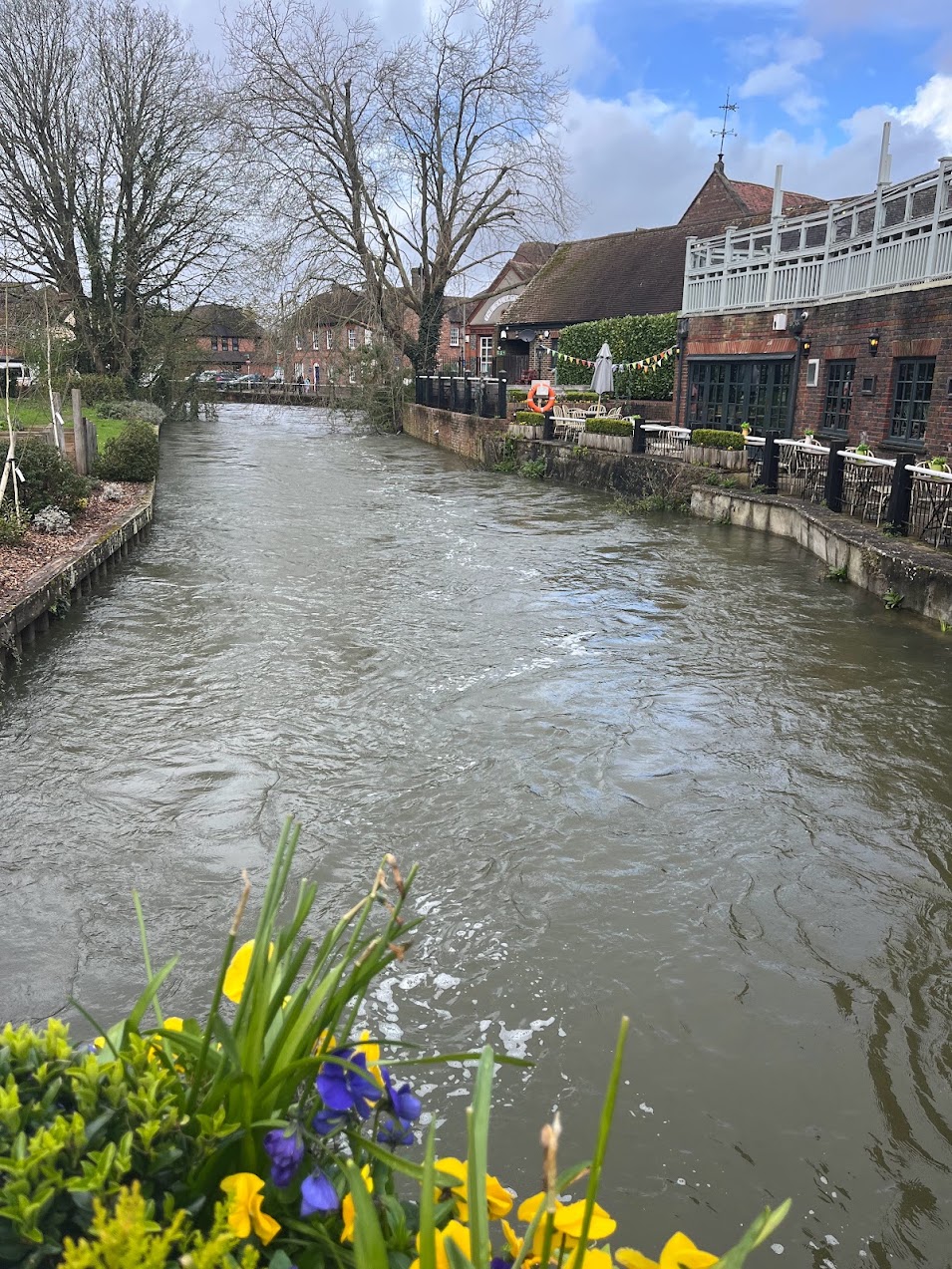
Six days after we nearly sank Tilly Mint while attempting to moor in Newbury, Chris and I returned to check on the boat—and decide whether it was safe to move her.
Our plan appeared straightforward: inspect the water levels and, if conditions had improved sufficiently, carefully take Tilly Mint back downstream.
Unfortunately, the Kennet & Avon Canal had other ideas.
Back to Newbury
The memory of our previous visit remained painfully fresh.
Strong flows had caught Tilly Mint as we attempted to moor, forcing her sideways and wedging her across the navigation. For 15 frightening minutes, we had struggled to regain control before five members of the public helped us bring her safely alongside the bank.
Leaving the boat in Newbury had been the only sensible option. Nevertheless, we remained concerned about her and hoped that a week of calmer conditions might allow us to move her somewhere safer.
As we travelled back to Newbury, we were cautiously optimistic.
That optimism did not last long.
The flooding had worsened
Rather than subsiding, the floodwaters had continued to rise.
The railway was disrupted by flooding, while replacement buses offered little assistance because several local roads were also affected. Simply reaching Newbury became considerably more difficult than expected.
It felt as though the entire transport network was delivering the same unmistakable message:
Do not move the boat.
When we finally reached the canal, the conditions confirmed it. Water levels remained dangerously high, the flow was powerful and the familiar waterway looked increasingly unpredictable.
Any hope of a gentle cruise back downstream quickly disappeared.
Assessing Tilly Mint
Our first priority was checking that Tilly Mint remained safe.
After the drama of the previous weekend, it was an enormous relief to find her still securely moored. We inspected the ropes, checked the boat and considered whether there was any safe way to move her.
There was not.
Attempting to set off would mean releasing Tilly Mint back into the same powerful flow that had overwhelmed us only days earlier—except conditions were now even worse.
Moving downstream might sound easier than travelling against the current, but strong water can carry a narrowboat far more quickly than expected. Bridges, bends, locks, weirs and moored boats leave very little margin for error once control is lost.
We had already received one warning. Ignoring the second would have been reckless.
The hardest decision was to do nothing
We had returned prepared to move the boat, but the responsible decision was to leave her exactly where she was.
It was disappointing. We wanted to take Tilly Mint somewhere safer and had hoped to spend the weekend aboard. After all the effort involved in reaching Newbury, turning around without cruising felt frustrating.
However, boating safely sometimes means accepting that the conditions—not the crew—will determine the plan.
No journey was worth risking the boat, ourselves or anyone who might once again have to come to our assistance.
We checked that Tilly Mint was as secure as possible, stepped back onto the towpath and left her to wait out the floods.
A lesson in patience
Canal boating is usually associated with freedom: releasing the ropes, choosing a direction and travelling at your own pace.
This experience reminded us that the waterways always retain the final say.
After prolonged rainfall, water levels and flows can change quickly. A stretch that normally appears calm can become hazardous, and confidence gained in ordinary conditions may offer little protection when nature behaves differently.
Knowing how to handle a boat is important. Knowing when not to move it can be even more important.
Waiting for calmer water
Our return to Newbury was not the adventure we had hoped for.
There was no cruise, no peaceful evening aboard and no satisfying moment when we finally carried Tilly Mint away from the scene of our narrow escape.
Instead, there was a careful inspection, a difficult decision and a journey home.
Yet doing nothing was unquestionably the right choice.
Tilly Mint would remain in Newbury until the floods subsided and the Kennet & Avon Canal became safe enough to navigate again. Our next adventure would simply have to wait.
Sometimes the most successful boating trip is the one during which the boat does not move at all.